Tennessee opens FY27 LEAPS grant competition; $2,000 per-student allocation, applications due April 10
Loading...
Summary
The Tennessee Department of Education outlined the FY27 LEAPS competitive grant: awards use a $2,000 per-student allocation (min $50,000; max $500,000), serve K–12 youth in 15 hours/week over 160 days, and require an intent to apply by Jan. 30 and ePlan submissions by April 10, 2026.
Anessa Ladd, extended learning grant manager at the Tennessee Department of Education, summarized the FY27 Lottery for Education After School Programs (LEAPS) grant and key deadlines during a technical-assistance webinar. She said the Request for Application (RFA) will be posted in ePlan when applications open Feb. 1 and emphasized the notice of intent to apply is due Friday, Jan. 30.
The department described the award structure and eligibility. According to Ladd, awards are based on a per-student allocation raised to $2,000, with a minimum grant of $50,000 and a maximum of $500,000. Grants are competitive and awarded for three years “providing that the project is achieving the desired outcomes,” and the presenters said LEAPS grantees must reapply and compete to continue funding after that period.
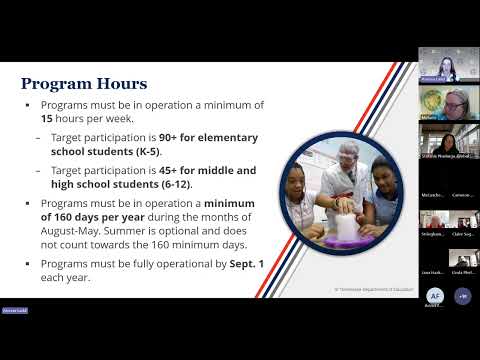
Programs funded by LEAPS must operate at least 15 hours per week and 160 days per year (August–May), be fully operational by Sept. 1, and provide enrichment that supplements — not supplants — existing educational resources. Ladd outlined participant eligibility: programs must serve youth ages 5–18 (K–12); pre-K is excluded. At least 50% of enrolled students must meet one or more risk indicators, including eligibility for free or reduced-price lunch, being at risk due to neglect or disability, or attending a public school identified for low performance.
The department also listed statewide performance goals grantees must address, including academic growth in reading and mathematics, reduced chronic absenteeism, positive behavior changes, sustained engagement, family engagement, and early‑learner reading gains for K–2. Programs are required to collect outcome data and participate in local evaluation reporting at three points each year: initial, mid-year and end of year.
Applications will be subject to peer review using the technical‑merit rubric (Appendix A of the RFA). Presenters warned that prior negative performance (failure to serve expected attendees, late reporting, data‑quality failures, or not expanding previous funds) will reduce peer review scores. Notifications to applicants — whether awarded or not — are expected in July following peer review in April and May.
The department also stressed compliance monitoring: grantees may be monitored via desktop or on-site reviews and risk-based selection; failure to serve expected numbers or make significant progress toward performance goals may result in loss of funding.
The webinar concluded with reminders to submit the notice of intent by Jan. 30, read the RFA and ePlan instructions carefully, and submit a completed application in ePlan by Apr. 10, 2026, at 11:59 p.m. Central time with the LEA-authorized representative approval in place.