Get Full Government Meeting Transcripts, Videos, & Alerts Forever!
Get email alerts on the Land Capacity Rezoning topic
No spam. Unsubscribe anytime.
Ellensburg staff propose seven rezones to meet 20-year housing targets
Summary
City planning staff presented a land capacity analysis showing shortfalls in lower- and middle-income housing and proposed seven modest rezones to add capacity within city limits rather than expand the urban growth area.
Stacy Henderson, planning manager for the City of Ellensburg, told the study session on Feb. 2 that a land capacity analysis (LCA) led by Leland Consulting shows the city can meet its 20-year housing targets primarily through targeted rezones rather than expanding the urban growth area.
Henderson said the LCA follows Department of Commerce and Kittitas County methodology and counts development since 2020 and known pending projects toward required housing targets. "A lot of the chapter drafts are due in June, and we are still on track to finish those drafts in June as planned," she said during the presentation.
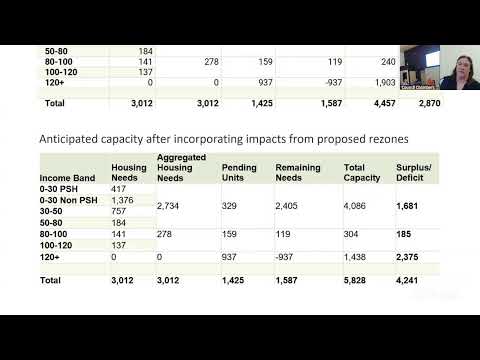
Andrew Alber of Leland Consulting described how the analysis aggregates income bands into housing need categories and subtracts pending units to calculate remaining needs. "Pending units" are projects already underway or permitted since 2020 that reduce the number of additional units the city must plan for, Alber said.
Staff presented seven proposed zoning changes intended to increase capacity for middle- and lower-income housing: convert certain Residential Suburban parcels to Neighborhood Center Mixed Use (NCMU) near the old canal; reclassify parcels along West University Way from Commercial Highway to Central Commercial; change parts of University Way and nearby corridors to Regional Center Mixed Use (RCMU) to allow multifamily housing; rezone parcels near East Helena and Northwater to NCMU; rezone North Airport Road parcels to NCMU; and combine Residential Suburban and Residential Low into a single Residential Low zone with a minimum of 3 and maximum of 12 dwelling units per acre to allow duplexes, townhouses or cottage housing.
Henderson said those changes, when run through the LCA assumptions, bring the city "over our capacity in a comfortable amount" relative to state-allocated targets, and that commissions broadly supported moving forward with all seven changes at a joint meeting in January. "Staff took a kind of a gut check at that meeting, and with a few small suggestions, fairly consistent feedback, almost unanimous, I think, was to continue with proposing all 7 changes," she said.
Council members pressed staff on what the rezones would actually produce on the ground. One council member asked whether rezoning a large parcel to mixed use could simply create a single big-box development rather than a mix of housing and retail. Henderson replied that code places size limits and conditional-use requirements on large stores in the Neighborhood Center Mixed Use designation, and staff factored an anticipated residential percentage into capacity calculations, but the code does not mandate a fixed ratio of commercial to residential across a rezoned area.
Staff and consultants also clarified that the LCA counts only parcels classified as vacant, partially used or redevelopable inside the proposed change areas; rezoning a shaded area on the map does not automatically mean every parcel there was counted as capacity. The consultants emphasized the methodology uses acreage and development assumptions to convert available parcels into unit capacity and that market interest and permitting remain significant variables.
There were no formal votes on the proposals during the study session. Henderson said the next steps include continued modeling, sending the proposals through the affordable housing and planning commissions, and preparing chapter drafts for the June schedule.
Ending: The council received the presentation and scheduled further review; staff offered to circulate an updated slide deck and capacity tables to the council.