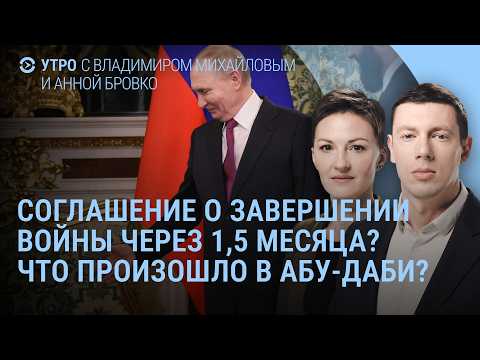
U.S. sanctions on Rosneft and Lukoil cited as leverage in Abu Dhabi talks; analyst calls results limited
Loading...
Summary
The broadcast reported a U.S. official saying sanctions on Rosneft and Lukoil pushed Russia to talks in Abu Dhabi; Arkady Moshes, a Finland-based Russia analyst, said sanctions ‘play a role’ but the negotiations were constructive yet inconclusive and did not show major progress.
U.S. sanctions on Russian oil giants Rosneft and Lukoil were presented in a morning broadcast as a factor that brought Russian representatives to recent talks in Abu Dhabi, but a guest analyst said the measures alone are unlikely to force a settlement.
The program cited a U.S. finance official named in the broadcast as Scott Bessand, saying the sanctions “brought Russia to the negotiating table.” The broadcast then connected to Arkady Moshes, introduced as director of the Russia program at the Finnish Institute of International Affairs, who questioned that characterization. “Не совсем,” Moshes said. “Переговоры прошли конструктивно, но безрезультатно.”
Moshes told the program that, while rising U.S. sanctions can “play a role,” Moscow still appears oriented toward securing military gains. He argued that territorial recognition of the four occupied regions and formal guarantees for a land corridor to Crimea would amount to what Moscow regards as a military victory. “Военной победой для России будет признание российского статуса тех четырех областей…,” he said.
The broadcast also reviewed reporting that delegates agreed to continue trilateral consultations and report to their capitals, but produced no public breakthrough. Russian special envoy Kirill Dmitriev was reported to have said publicly that progress existed before the second day of talks, though no post-meeting statement followed.
Separately, the program cited a Washington Post report that Russian officials warned President Vladimir Putin of possible economic difficulties this summer and mentioned a Kremlin-linked macroeconomic center’s assessment of banking stress. The broadcast noted that oil and gas revenues in January were reported to have fallen by roughly half year-on-year, the lowest in five-and-a-half years, a detail the hosts linked to pressure on Moscow’s finances.
The program concluded that while sanctions may be increasing pressure, Moshes and other analysts on the broadcast said they do not yet see economic distress sufficient to force a shift in Moscow’s strategic preference for military options. The Abu Dhabi consultations are expected to continue in follow-up talks and bilateral reporting to capitals.
The broadcast attributed casualty estimates and some analytical claims to external reporting — for example, a CSIS report cited by the program saying Russian losses approached “almost 1,200,000” when counting killed, missing and wounded; that figure is reported as the program presented it and is not independently verified in this article.
Next steps: delegations will report results to their capitals and the trilateral consultations will continue in coming weeks, according to the broadcast.