
Maryland Insurance Administration cites Salesforce rollout, rising project costs in FY27 budget hearing
Get AI-powered insights, summaries, and transcripts
Subscribe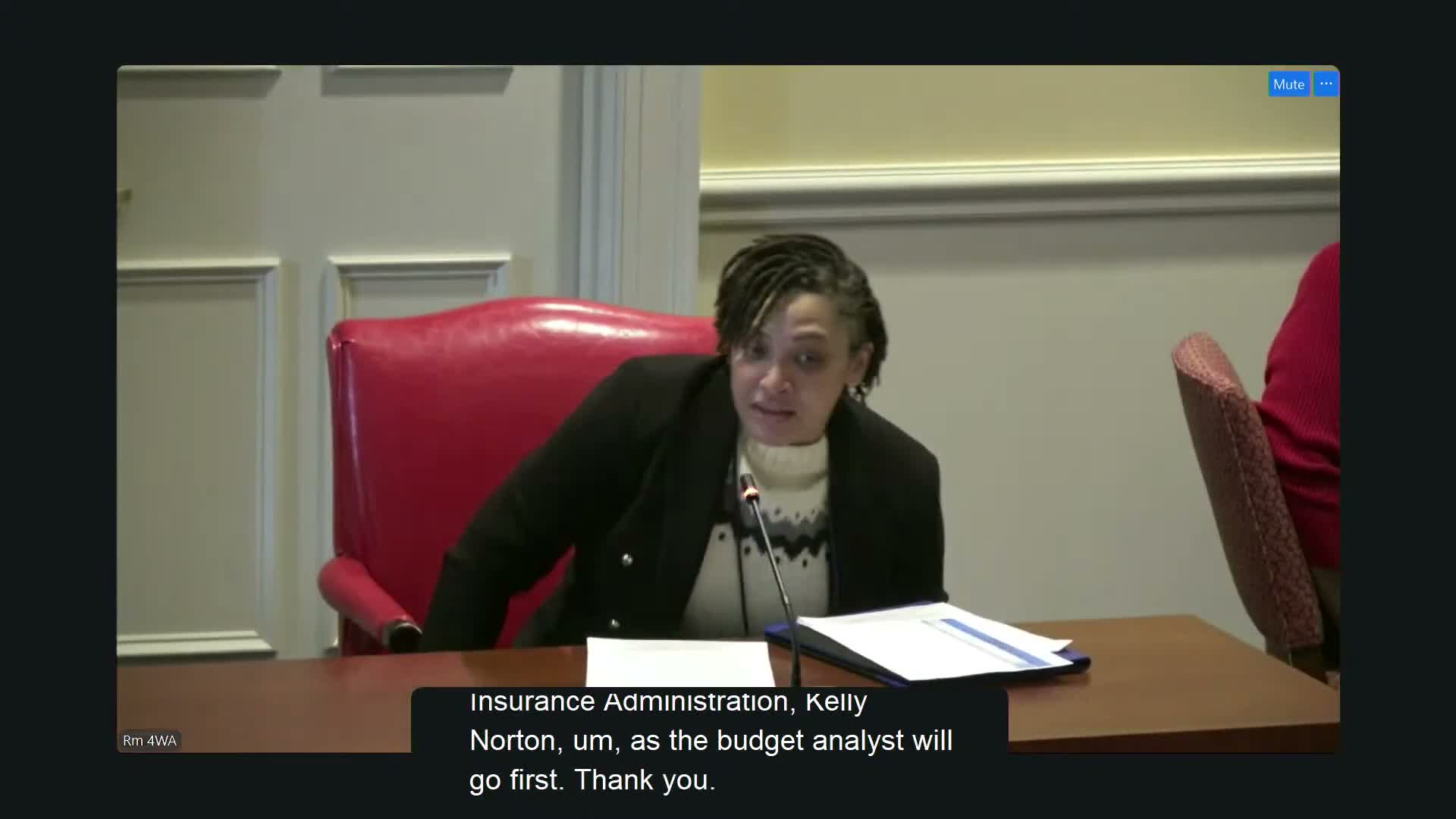
Summary
MIA told a legislative subcommittee its insurance tracking system—now built on Salesforce—has improved workflow but pushed total project costs from a prior $18.1M estimate to an updated $30M–$40M range; agency officials said full deployment across major units is expected by the end of fiscal 2027.
The Maryland Insurance Administration told the Public Safety, Transportation, and Environment Subcommittee on Feb. 6 that a multi‑year effort to modernize its legacy complaint and licensing systems has moved onto a Salesforce platform but widened cost projections.
Department data presented by the Department of Legislative Services showed the MIA fiscal 2027 operating allowance at $59,300,000, a 3.2% increase from fiscal 2026, with personnel accounting for 65% of the budget. DLS reported that the insurance tracking system appropriation rises in FY27 from $7.7 million to $8.7 million and that the program’s total projected cost has grown from an earlier $18.1 million estimate to a new range between $30 million and $40 million.
Deputy Commissioner Joy Hatchett, speaking for the agency, acknowledged a failed early procurement and described the decision to use a DoIT master contract with Salesforce to regain momentum. Hatchett said the agency completed Phase 1 in May 2025, has added an experienced project manager and a Salesforce developer, and expects most major units to be fully deployed by the end of fiscal 2027. “I think that we will be fully up and running by the end of fiscal year 27 across our agency,” she said.
DLS raised performance concerns about complaint resolution timelines. DLS reported more than 7,100 property and casualty complaints received in fiscal 2025 but said only 44% were resolved within 90 days (up from 36% in 2024), short of past goals. Hatchett and agency testimony attributed improved closure counts to a 2025 reorganization, added resources and early Salesforce pilots in the fraud division; the fraud unit’s earlier Salesforce adoption was cited as a model for other units.
DLS also described a new tiered approach for fraud investigations, with different closure-time expectations by complexity (tier 1 through tier 3). The subcommittee’s recommended committee narrative asks MIA to report back on project progress and both actual and estimated project costs.
The hearing included discussion of recruitment and retention challenges for specialized staff, efforts to reestablish workforce and education advisory committees, and proposed legislation related to low‑cost automobile insurance and credit-relief options that the agency plans to introduce this session.
The committee did not take formal action during the hearing; DLS’s recommendation asks MIA to provide updated progress reports on the insurance tracking system and to explain plans to raise complaint-resolution rates.