
Agency outlines playbook, training and a cautious path to weighted funding under Act 73
Get AI-powered insights, summaries, and transcripts
Subscribe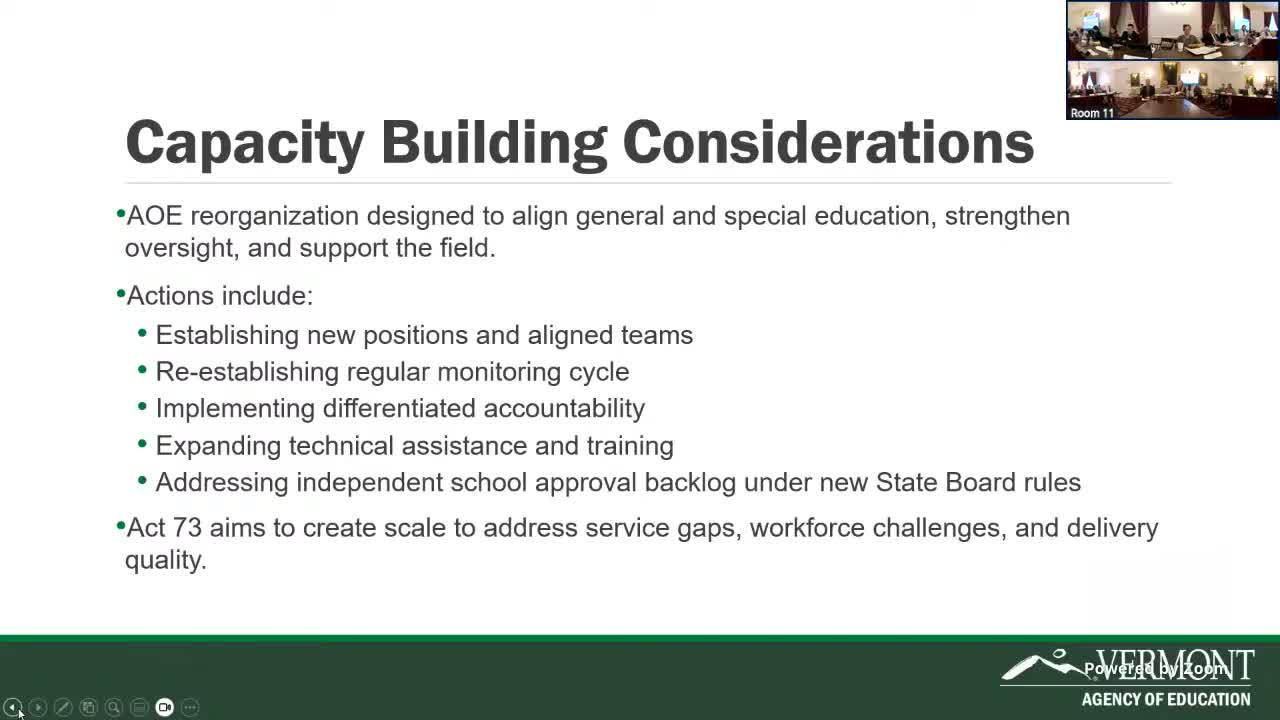
Summary
Secretary Zoe Saunders described organizational changes, a playbook and toolkit for Act 173 implementation, boot‑camp training and regional coaching, and said the agency commissioned a separate study (with Joint Fiscal Office coordination) to evaluate conditions for moving to the Act 73 weighted funding model, cautioning about federal MOE/MFS constraints.
The Agency of Education presented a strategic plan and near‑term implementation steps intended to improve special education delivery and to support any contemplated funding changes under Act 73.
"We are developing a playbook, which will also have an accompanying toolkit to guide and monitor strong implementation," Secretary Zoe Saunders told the joint committee. The agency described a reorganization that elevates special education leadership (naming Dr. Erin Davis as chief academic officer) and adds roles for special‑education finance and grants management to improve oversight and financial alignment.
Saunders said the agency will move beyond guidance documents toward a combination of statewide training, coaching, and monitoring. The plan calls for a spring boot camp on effective systems support, followed by summer and fall regional convenings and one‑on‑one coaching for district systems. The agency also described a cyclical monitoring approach, steering committees to set measurable targets, and an annual statewide planning retreat to track progress.
On funding, Saunders cautioned committees to consider federal requirements before changing funding structures. "It is important to keep in mind the federal rules governing, our IDEA," she said, and warned that state maintenance of fiscal support (MFS) and local maintenance of effort (MOE) rules could limit options. The agency has "commissioned a separate study to evaluate that, and that study will be available to you this legislative session," she said, and indicated coordination with the Joint Fiscal Office on a timeline that could include April deliverables.
Committee members asked about timelines and staffing; the agency said several leadership posts are filled, others are posted, and the strategic plan coordinator position was in final interview stages. Saunders said the agency intends the strategic plan to be operational rather than a shelf document, with steering committees accountable for progress monitoring and the agency prioritizing measurable targets tied to the strategy's five pillars.
Members asked for follow‑ups on details—sequencing of boot camps and convenings, fiscal modeling under different funding scenarios and data needed to ensure changes would not violate MOE/MFS rules—and the agency committed to return with additional documents and data.