
Agency report: intensity of special‑education needs, not overall caseload, is driving cost growth
Get AI-powered insights, summaries, and transcripts
Subscribe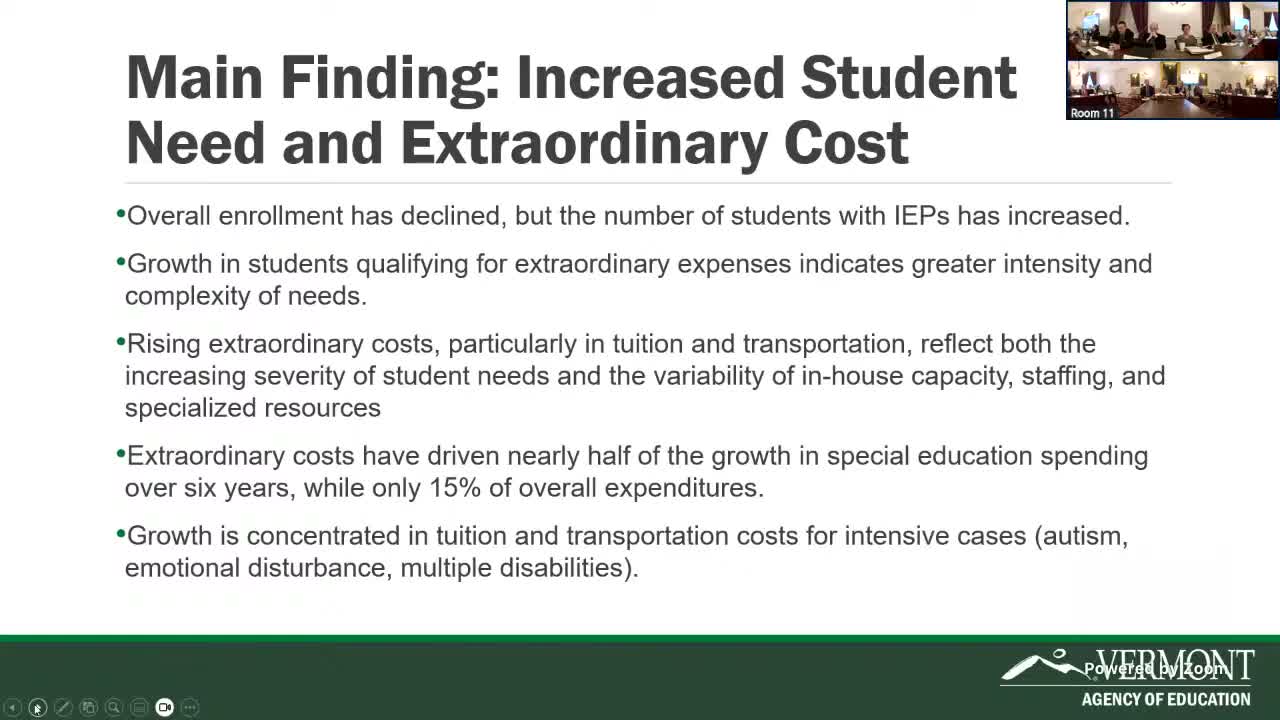
Summary
Agency of Education officials told a joint House Ways & Means and House Education hearing that Vermont’s number of students with individualized education programs (IEPs) has risen even as total enrollment fell, and that extraordinary costs—dominated by autism and emotional‑disturbance cases—account for roughly half of spending growth despite comprising about 15% of total special‑education dollars.
Secretary Zoe Saunders and Agency of Education staff presented a statutorily required review of special education delivery and costs, saying higher‑intensity cases are the central driver of recent spending increases.
“Overall enrollment has declined, but the number of students with IEPs has increased,” said Dr. Erin Davis, the agency’s chief academic officer, summarizing a key finding that rising extraordinary costs—principally tuition and transportation for more intensive placements—have driven nearly half of special‑education spending growth over six years while making up only about 15% of total special‑education expenditures.
The agency’s presentation cited measurement changes and growing intensity in particular disability categories. Anna Russo, the agency’s technical assistance and professional development manager, explained that a federal change in how preschool and kindergarten age groups were counted (effective in 2021) partly altered the visual trends but does not fully explain recent increases in school‑age IEP counts. The slides list roughly 16,000 students on IEPs (the presentation cited ~16,152 for one year and ~16,354 for a later year) and show autism and "other health impairment" categories rising sharply; the agency said autism primary‑category prevalence rose about 33 percentage points between 2019 and 2025 in their dataset.
Agency fiscal staff told members that extraordinary reimbursements have grown faster than other revenue categories (reimbursement, census block grants, IDEA, Medicaid) and noted the state’s excess‑cost grant is being used more frequently for high‑need students. Committee members and several business managers pressed whether reimbursement rules create incentives to place students out‑of‑district because those placements can yield higher reimbursements. Secretary Saunders said the reimbursement formula was reviewed last spring and that adjustments allowing increased reimbursement rates had been discussed; she said the agency would revisit that analysis and provide follow‑up.
The report also highlights a distinctive placement pattern in Vermont. The agency said about 82.32% of students on IEPs spend 80% or more of the day in regular classrooms (the agency called that the least‑restrictive setting), while Vermont also has a higher share of students placed in separate schools (about 5.27%) than peer states and the national average. Agency staff described this as an "all‑or‑nothing" pattern in which intermediate placement options (40–79% of the day) are used less frequently, noting that limited local capacity, staffing and specialized resources likely contribute to that pattern.
Agency presenters repeatedly emphasized data gaps—particularly limited visibility into in‑district specialized programs and inconsistent data on fidelity of evidence‑based Tier 1 instruction—and said these gaps hinder confident causal claims about drivers for placement and spending. The agency committed to follow‑up reporting with more granular breakdowns by LEA and by disability category to support further analysis.
The hearing closed with committee members requesting additional data on eligibility definitions (for example, emotional disturbance), classroom‑level performance, and a deeper analysis of reimbursement incentives; agency staff agreed to return with further materials.