
Kentucky Senate passes bill clarifying local control over massage businesses, raises concerns about harsher misdemeanor penalties
Get AI-powered insights, summaries, and transcripts
Subscribe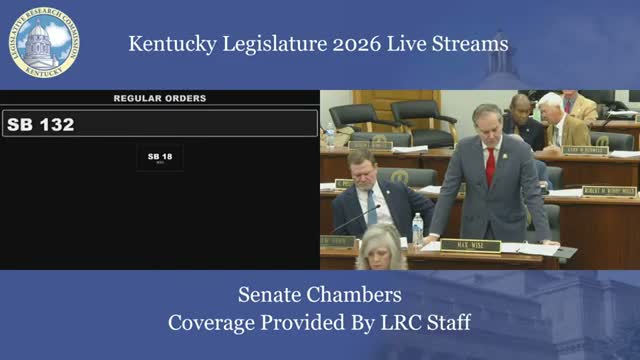
Summary
The Kentucky Senate unanimously passed Senate Bill 132 to affirm local authority to regulate businesses operating as massage establishments and to increase penalties for unlicensed massage practice; several senators flagged concerns that elevating the offense to a class A misdemeanor could unintentionally punish trafficking victims without stronger victim protections.
Senate Bill 132 cleared the Kentucky Senate on Feb. 6, 2026, after floor debate that centered on local regulatory authority and criminal penalties for unlicensed massage practice. The bill, explained on the floor by Senator Campbell, clarifies that nothing in state law limits a local government’s authority to adopt and enforce ordinances related to zoning, local business licensing, inspections, advertising, hours and sanitation for businesses that represent themselves as massage parlors.
Senator Campbell told colleagues the measure is “more about massage being masked in fact as *** trafficking” and that the bill aims to give cities tools to investigate complaints and address illegal activity while “leaving regulations of the practice of massage therapy itself with the state.” She also described a change in penalties that “strengthens enforcement of massage therapy licensing requirements by increasing the penalty for violations … from a class b misdemeanor to a class a misdemeanor and making each unlicensed massage therapy session a separate offense.” The bill retains existing affirmative defenses, she said, including protections for victims of human trafficking.
Several senators spoke in support while flagging limits. The senator from Jefferson (seat 19) said she would vote for the bill but cautioned that, as written, it could ensnare trafficking victims. She noted estimates “from the human trafficking hotline … as many as 7,000 to 9,000 individuals who are trafficked just to massage parlors in the United States,” and urged an amendment requiring the person to “knowingly and willingly hold themselves out as an unlicensed massage therapist” so the law would not broadly criminalize coerced behavior.
The clerk called the roll and the presiding officer announced the final tally as 32 yay votes, no nay votes; Senate Bill 132 passed. Multiple senators asked to explain or change their votes on the record during the roll call process; the transcript records several members saying they would ‘‘cast an I vote’’ and offering brief explanations of reservations and support.
What the bill does: it affirms municipal powers to regulate businesses that market as massage establishments, enumerates local regulatory levers (zoning, local occupational licensing, inspections, advertising, hours and sanitation), and elevates penalties for unlicensed practice while retaining affirmative defenses for trafficking victims, according to floor statements.
What remains unsettled: senators who supported the bill asked the sponsor to work with colleagues to add clearer safeguards for victims so that prosecutorial discretion is not the sole protection. The transcript records those concerns but no amendment or change to the bill text was offered on the floor during this session.
Senate Bill 132 passed the Senate; further procedural steps beyond the Senate floor were not specified in the transcript.
Ending note: During debate senators repeatedly emphasized the aim of protecting vulnerable people and giving local officials clearer tools to investigate suspicious businesses, while warning lawmakers to avoid criminalizing trafficking victims without explicit statutory safeguards.