Get Full Government Meeting Transcripts, Videos, & Alerts Forever!
Get email alerts on the Land Use topic
No spam. Unsubscribe anytime.
Hialeah delays vote on church-owned lot plan for RV and boat parking after residents raise safety and nuisance concerns
Summary
A proposed conversion of a church-owned parcel at 1550 W. 60th St. into an 81-space recreational-vehicle and boat parking facility was presented on first reading Jan. 27 and drew sustained questioning from council and neighbors over security, drainage, hours and neighborhood fit. The council postponed the land-use and rezoning items to Feb. 24 to allow more community engagement and covenant detail.
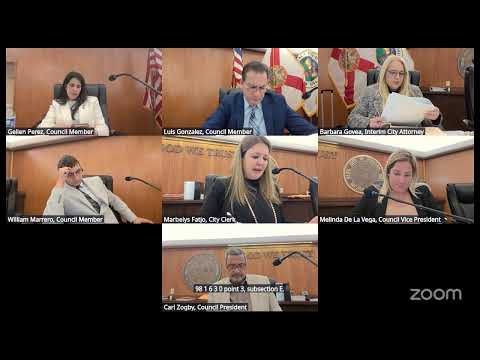
The Hialeah City Council postponed action Jan. 27 on a developer-backed plan to convert a 1.08-acre church-owned parcel at 1550 W. 60th Street into a commercial recreational-vehicle and boat parking facility after a lengthy presentation and wide-ranging resident and council concerns.
Architect Manny Rose, representing the property owner and developer, described the proposal as a secured surface parking facility with 81 assigned spaces — including three handicap spaces — and a pedestrian connection between 60th and 58th Streets. Rose said the facility would be limited to recreational vehicles and boats, would not provide water or electricity to stalls, and would include landscaping and security cameras. "These are strictly recreational vehicles," Rose said, emphasizing screening and site controls.
But multiple councilmembers and nearby residents questioned how the site would be monitored, whether gates and cameras would prevent overnight occupation, how vehicles would enter and exit during peak hours near a school, and how the project would fit in a largely single-family neighborhood. Vice president de la Vega said she was "very surprised" to learn the parcel would become a parking lot and told the architect, "I don't feel that this would be a good project," citing neighborhood character and resident complaints.
Planning staff read a draft declaration of restrictions the applicant has offered that would become part of the covenant if the project proceeds: the property would be limited to recreational vehicles and boats; operations would be prohibited between 11 p.m. and 5 a.m.; commercial trucks, mechanical repairs, maintenance or cleaning of vehicles on-site would be prohibited; a 6-foot precast wall and lush landscaping would be required along property lines adjacent to single-family homes; no sewer or water hook-ups would be allowed; and the applicant would submit to monthly code-enforcement inspections once operations begin. The covenant would also require the owner to remove any vehicle suspected of being used as a residence within 24 hours.
After hearing dozens of questions and suggestions — including requests for a stronger, visually opaque buffer, a commitment to on-site security, limits on who may rent spaces, and clarification on enforcement — the council voted to postpone both the land-use amendment and rezoning until the Feb. 24 meeting to allow the applicant to return with clarified covenants and additional community engagement. The clerk recorded the postponement motion and roll-call vote.
Next steps: The applicant will meet with city planning staff and council offices to refine the covenant and answer specific concerns about gating, monitoring, hours, drainage and traffic. The matter will return to the council in a future meeting for further review and possible approval or denial.