Committee rejects bill that would reset DOT capital baseline to highlight a $150M need
Loading...
Summary
After hours of testimony from DOT officials, the Transportation Committee voted 'ought not to pass' on LD 1804, a proposal to present a $150 million baseline capital budget for DOT to increase visibility of a long-term structural funding gap; members debated procurement, budgeting mechanics, and revenue-neutral scenarios moving liquor revenue and DPS costs to the general fund.
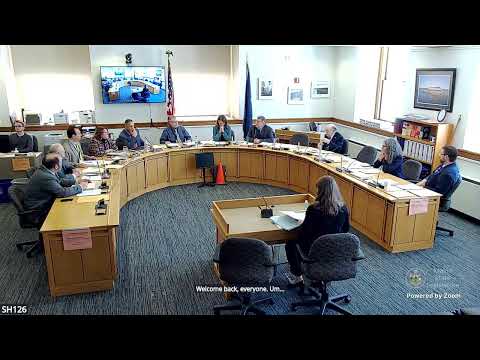
The Transportation Committee voted 'ought not to pass' on LD 1804 during its Feb. 5 work session after an extended review of the bill’s mechanics, fiscal scenarios and programmatic effects.
LD 1804 would have created a baseline capital figure (staff illustrated a hypothetical $150 million) for the Department of Transportation to use in biennial budgeting, reversing the usual pattern of starting from zero and building up. Committee analysts presented two fiscal scenarios for how the change could be made revenue-neutral: shifting liquor revenue and certain DPS accounts out of the Highway Fund into the General Fund and offsetting the move with increases to the auto-related sales tax (examples discussed included a full swap and partial-percentage alternatives).
DOT testimony: Catherine Wilczek, DOT director of finance and administration, and Commissioner Dowdy told members the baseline approach is largely a matter of perspective and transparency: it shows a department’s capital 'need' rather than relying on rolling residuals of available revenue. Wilczek warned, however, that if revenue is not available the executive would need to submit initiatives that reduce capital lines to produce a balanced budget.
Procurement and operations: Members pressed DOT about procurement language in the sponsor’s amendment, which removes a 'project-specific' limitation to permit forward purchasing of items (for example, culverts) to improve emergency response capability and supply efficiency. DOT officials said the change preserves competitive bidding, records and oversight, and helps in emergency procurements like those used during COVID.
Fiscal tradeoffs and concerns: Committee members repeatedly raised that converting a baseline figure into a durable funding increase would require new or reallocated revenue. Staff presented two illustrative models showing varied impacts to the Highway Fund depending on percentage choices and whether liquor revenues and DPS costs were moved to the General Fund. Commissioner Dowdy and members described a longstanding structural shortfall (DOT staff cited an estimated annual gap on the order of about $170 million for a maintaining-level program) and emphasized that the bill highlights, rather than immediately solves, that gap.
Vote and next steps: Representative Lydia Crafts moved 'ought not to pass' on LD 1804; the motion carried on the committee floor (a roll-call number '6' was recorded on the transcript during the vote). Committee members said the minority report would include amendments and alternate funding approaches for future consideration.