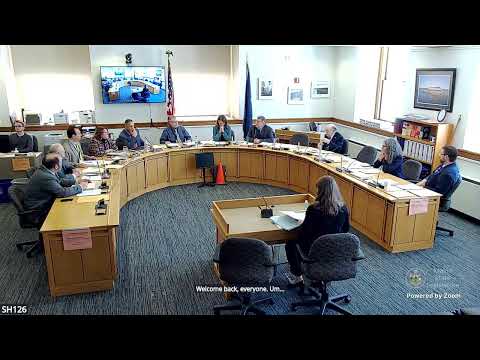
Committee refines driver safety barrier bill, narrows scope and trims fund to $1 million
Loading...
Summary
Lawmakers reviewed final language for LD 2062, focused on definitions for ‘‘large heavy duty buses,’’ limits coverage to urban fixed-route providers serving municipalities over 20,000 people, and reduced a dedicated appropriation from $2 million to $1 million; committee directed staff to confirm technical definitions before final language.
Lawmakers on the Maine Legislature’s Transportation Committee spent a sizable portion of their Feb. 5 work session refining LD 2062, legislation that would require driver safety barriers on certain public transit buses.
The committee’s analyst, Melanie Fuhrman, presented final-language edits and said the bill now includes a new definition of a “large heavy duty bus” (a vehicle with a gross vehicle weight of 26,001 pounds or greater and a length described in the draft). She told members the sponsor intended the measure to be narrow and that the revised text would apply to urban fixed-route transit providers that serve a municipality with a population greater than 20,000.
Why it matters: Committee members said the change narrows the bill’s reach so it targets higher-capacity buses typically used in denser municipalities, rather than every transit vehicle statewide. Representative Lydia Crafts said she supported the sponsor’s approach and thanked staff for compiling the language.
Key details: Committee discussion focused on three technical questions. First, members debated whether the size definition should use weight OR length (which would capture buses that meet either measurement) or require BOTH conditions. Senator Theresa Perce and others asked staff to confirm whether some medium-size buses (for example, 30-foot vehicles) meet the 26,001-pound threshold and asked the sponsor to return with a clarified definition.
Second, the bill was revised to include glare-minimizing materials in its definition of vehicle security barriers but also to preserve the operator’s line of sight to exterior mirrors and the roadway.
Third, the funding mechanism was pared back: the draft appropriation was reduced from $2,000,000 to $1,000,000 and the language includes a lapse date for any remaining funds. Fuhrman read committee language specifying that any funds remaining after Aug. 1, 2029, would lapse back to the state’s general fund and that the dedicated fund could not be used for ongoing maintenance of barriers.
On enforcement and implementation: The draft requires that covered buses be equipped with barriers before operating in covered municipalities; if a vehicle lacks the equipment it cannot be put into service in those municipal jurisdictions. Members asked whether new buses are commonly delivered with barriers; Commissioner Catherine Wilczek said industry practice is that most new buses come with driver protection features, although she could not guarantee it for every fleet.
What’s next: Staff pledged to confirm technical vehicle-weight/length thresholds and report back at the next meeting. The committee did not adopt a final vote on the bill text at this session.
Sources: Committee presentation and exchanges with Melanie Fuhrman and Commissioner Catherine Wilczek during the Feb. 5 work session.