Get AI Briefings, Transcripts & Alerts on Local & National Government Meetings — Forever.
Regional steering committee directs staff to produce an asset map to coordinate homelessness, workforce and parks
Summary
A joint city–county–school committee asked staff to compile an asset map and return recommendations on up to three priorities — homelessness, workforce development and parks/open-space — and discussed staffing, metrics and possible joint investments in shelter capacity.
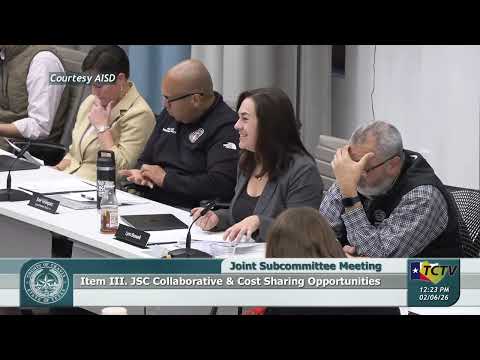
A regional joint steering committee on interjurisdictional services on Thursday directed staff from the participating entities to assemble an asset map and return recommended priorities and deliverables for coordinated action.
The committee asked staff to focus initially on no more than two or three topics and to present a common template so each jurisdiction reports the same categories of information. Members repeatedly identified homelessness, workforce development and parks/open‑space management as candidate priorities.
"We're all facing budget constraints," said Speaker 1, who opened the meeting by urging the jurisdictions to consider cost‑sharing and to rely on professional staff to make collaboration work. "If we're going to do this, the public has to trust that we're actually doing something that's more efficient… it needs to be straightforward."
Why it matters: committee members said an asset map will show what services, facilities and interlocal agreements already exist across the city, Travis County and Austin Independent School District, and where coordinated investments could yield faster, cheaper results. The effort is intended to reduce duplication and make it easier for residents to access services through joined‑up programming and clearer referral pathways.
What the committee asked staff to do: members requested a baseline inventory that includes current programs, facilities, funding sources and capacity (including FTEs where available), and a common set of success metrics so the jurisdictions can track progress. Staff were asked to identify where short‑term gains are possible and where phased work plans are required.
Staffing and timing: participants debated whether to appoint a jointly funded staff lead or to contract the project to an outside researcher. Speaker 10, Stephanie Hayden, assistant city manager, said the city typically assigns subject‑matter staff to compile information and suggested the city would coordinate initial outreach to homelessness, parks and workforce staff. Multiple members proposed that each entity gather initial building‑block data and then collaborate on a single asset‑map report. Members discussed returning recommendations at the committee’s next quarterly meeting, targeting mid‑May as a possible timeframe.
Homelessness, shelters and housing investments: homelessness drew sustained attention as a cross‑jurisdictional issue that shapes school stability and public‑safety resources. Speaker 1 proposed a concrete joint‑investment goal as an example — "50 new family shelter beds" — and urged the committee to explore family shelter capacity and youth‑aging‑out supports.
Speaker 5 noted recent Travis County investments from federal pandemic relief: "We got $247,000,000," Speaker 5 said, and the county placed $117,000,000 into creating permanent supportive housing, projects that county staff expect will yield about 1,900 housing units for people transitioning out of homelessness.
Workforce and parks: speakers urged the asset map to connect education and training pipelines to employer demand. One participant cited packet projections that infrastructure occupations could have about 5,000 openings by 2030 and technology about 22,000 openings, calling for clearer alignment between AISD, Austin Community College and regional employers. For parks, speakers suggested mapping facilities, equipment and maintenance staffing so jurisdictions can avoid unnecessary capital expenses and create shared operations where practical.
Partners and next steps: committee members recommended including health partners (Central Health, Integral Care, CommuniCare/Sendero), nonprofits such as LifeWorks, and higher‑education partners (LBJ School, Dell Medical School, Austin Community College) in working groups. The committee agreed to ask staff from the three represented entities to collect the baseline data, propose a timeline and return the asset‑map framework at the next meeting.
The meeting concluded with recognition of staff work and the chair moving to adjourn. The meeting was adjourned at 1:26 p.m.