Get Full Government Meeting Transcripts, Videos, & Alerts Forever!
Get email alerts on the Governance And Votes topic
No spam. Unsubscribe anytime.
Votes at a glance: claims, ordinance repeal and executive session approved
Summary
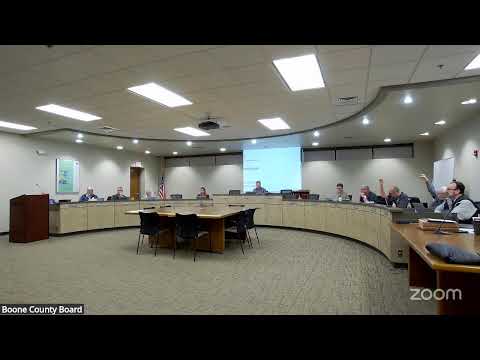
At the Feb. 5 Boone County meeting the board approved claims totaling $256,886.87, adopted Ordinance 2066 repealing a 1974 Boone County Code provision to align with state statute, allowed one member to join electronically, and voted to enter executive session for pending litigation and real-estate matters.
The Boone County Committee of the Whole on Feb. 5 voted on several procedural and formal items:
Approve electronic participation: The board approved a motion to allow Mr. Wahlberg to join the meeting electronically (motion moved and seconded; vote recorded as carried).
Approve agenda and minutes: The board approved the meeting agenda and minutes for 12/04/2025 and 01/08/2026 (including executive sessions) by voice/roll call vote; motions carried.
Claims approved: The board moved to approve claims in the amount of $256,886.87 with an expressed understanding in the motion that Charles Johnson would abstain on certain vendor/department claims. The motion was carried following roll call; the recorded roll-call responses in the transcript show affirmative responses from the members present and the chair declared the motion carries. (Transcript contains an inconsistency between the stated abstention in the motion and the recorded roll-call responses.)
Ordinance 2066 adopted: The state's attorney described Ordinance 2066 as a repeal of a 1974 Boone County Code provision (Chapter 70, Article 1, section 75) that could conflict with state statute; the motion to repeal was approved by the board.
Executive session authorized: The board voted to go into executive session to discuss pending litigation and the sale of real estate; roll call recorded ayes and the motion carried.
What was not specified: The transcript did not provide a complete, numbered roll-call tally for each motion (for example, abstentions referenced in motions are not consistently reflected in the subsequent roll call). Where the motion text included conditional abstentions, the official roll-call responses recorded in the transcript were treated as the governing record for whether the motion carried.