
Boone County officials debate fixes for dangerous Caledonia Road–Orth Road intersection
Get AI-powered insights, summaries, and transcripts
Sign Up Free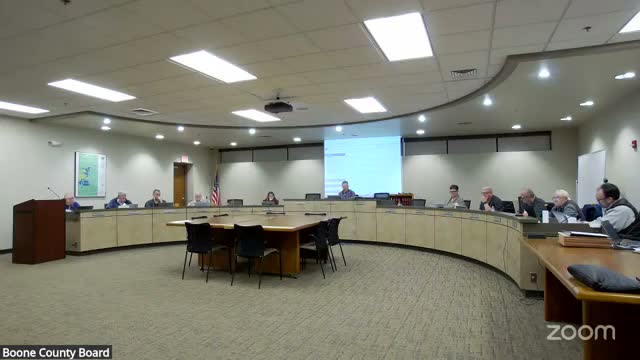
Summary
County engineers presented crash data showing rising severe collisions at Caledonia Road and Orth Road and outlined countermeasures from immediate, low-cost changes to a long-term roundabout; the board directed staff to return with a recommended plan.
County Highway Engineer Justin Crone urged the Boone County Committee of the Whole on Feb. 5 to treat the Caledonia Road–Orth Road intersection as a high-priority safety project after a recent string of serious crashes.
Crone presented four briefing sheets: an existing-conditions map, a historical crash analysis, a GIS heat map of county crash hotspots, and a list of potential actions. He told the board that average daily traffic on three legs of the intersection ranges from about 3,000 to 3,700 vehicles, while the east leg carries roughly half that volume. He said traffic on the west leg has grown about 50% over the past decade and that right-angle and rear-end collisions make up the largest share of crashes at the junction.
"We've seen a drastic increase in intersection accidents since 2022," Crone said, noting that the data show the highest number of collisions originate from the west leg entering the intersection. He described two geometry concerns — a roughly 23-degree skew of Caledonia and a 6.3% grade on the east leg — that complicate sight lines and vehicle control.
Crone laid out decision pathways: do nothing (not recommended); pursue an IDOT-sponsored Rural Safety Assessment (RSA); commission an intersection design study (IDS) — a technical consultant study Crone estimated at about $15,000 and roughly two months to complete — or take action without formal study. He then contrasted short-term, low-cost fixes (radar speed signs, additional pavement markings, a two-way or four-way stop with flashing beacons, rumble strips, vegetation clearing, high-friction surfacing) against long-term, higher-cost options such as a roundabout or an overpass.
"My recommendation would be to put a lot of countermeasures out there," Crone said. "Based on statistics, the long-term solution that reduces severity would be a roundabout at this intersection, but it's land intensive and takes time and funding to implement." He added that roundabouts are often 90% fundable under the federal Highway Safety Improvement Program, though funding is not guaranteed.
Board members probed whether a free RSA or IDS would automatically result in a roundabout recommendation. Crone replied that IDOT and RSA teams commonly recommend roundabouts for severe right-angle conflicts, but an IDS would present multiple scenarios and modeled crash-reduction estimates so the board could compare outcomes and costs.
Members raised implementation concerns: vegetation and sight-line removal (Crone said the county has site-triangle authority within the right-of-way and can negotiate with landowners for additional clearing), accommodation of farm equipment and large agricultural implements (members cautioned that roundabouts can be hard to navigate for large farm machinery), traffic staging during construction, and enforcement capacity (sheriff's staff said patrol resources are limited across the county's 280 square miles).
Some board members pushed for rapid, interim steps to reduce harm while pursuing a longer-term fix. Suggestions included converting the intersection to a four-way stop with flashing red lights, adding rumble strips, installing high-friction pavement at critical locations, and clearing vegetation.
Sheriff (name recorded in the meeting notes) told the board enforcement alone would not solve the problem, citing limited patrol capacity, but agreed that targeted enforcement details (often reimbursed through IDOT agreements) are possible when staffing allows.
The board stopped short of selecting a specific construction alternative. Chair closed the discussion by asking staff to return with a concrete plan of action and a recommended sequence of short-term and long-term measures. Crone agreed to prepare next steps and timing for the board’s review.
Next steps: staff will prepare a recommendation with cost estimates, an implementation timeline for immediate countermeasures, and options for pursuing an IDS or funding for a roundabout.