Get Full Government Meeting Transcripts, Videos, & Alerts Forever!
Get email alerts on the Utility Rates topic
No spam. Unsubscribe anytime.
North Bend holds first readings for water and sewer rate increases; public hearings continued to Feb. 17
Summary
Council held first readings and continued public hearings on ordinances proposing a roughly 6.5% average increase for water and 2.5–3% annual increases for sewer rates (2026–2031). Staff said the increases are needed to cover capital needs and long-term financial self-sufficiency.
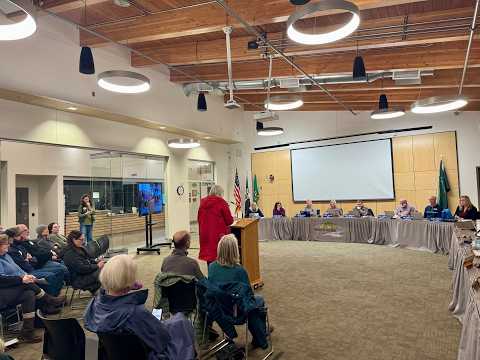
North Bend city staff presented a five-year water and sewer rate study Feb. 3 and council approved first readings for both proposed rate ordinances, continuing each public hearing to the Feb. 17 meeting.
Finance staff and consultant Sergei Tarasov of FCS Group said the study updates a 2021 analysis to account for historic inflationary pressure, deferred capital needs and growth. Tarasov said the water utility faces about $11 million in forecasted capital projects and recommended an average system increase of about 6.5 percent for 2026. For a typical single-family customer using 20 cubic meters, Tarasov estimated an approximate $4.56 monthly increase in 2026.
Tarasov said sewer capital needs are larger — roughly $41 million identified in the forecast period — but that about $25 million of the sewer program is expected to come from external grant funding, so recommended annual adjustments for sewer averaging about 2.5–3 percent. On a combined basis for water, sewer and stormwater, Tarasov said a typical single-family monthly bill would rise from about $221 to roughly $233.84 under the proposed schedule.
Council asked for additional modeling. Heather Collin asked whether comparisons included the private association Salal (also spelled variably in the packet) and whether the study accounted for development-driven revenues; staff said they modeled growth at about 2 percent for water and 2.5 percent for sewer and can provide a comparison to Salal and a model showing the impact of a potential single-system merger.
Council also discussed mitigation-water costs tied to an intertie with Salal. Staff said Solal/Salal intertie work completed in February 2025 will reduce mitigation payments to outside suppliers and that corresponding facility-charge obligations should decline toward zero by about 2028.
Council member Christina Rustick moved to approve AB26-013 (water rates) as a first reading and to continue the public hearing to Feb. 17; Rob McFarland seconded and the motion passed unanimously. Rustick made the comparable motion for AB26-014 (sewer rates); McFarland seconded and that motion also passed unanimously. Both items are scheduled for second reading and possible adoption on Feb. 17, with staff indicating a target implementation date of about April 1.