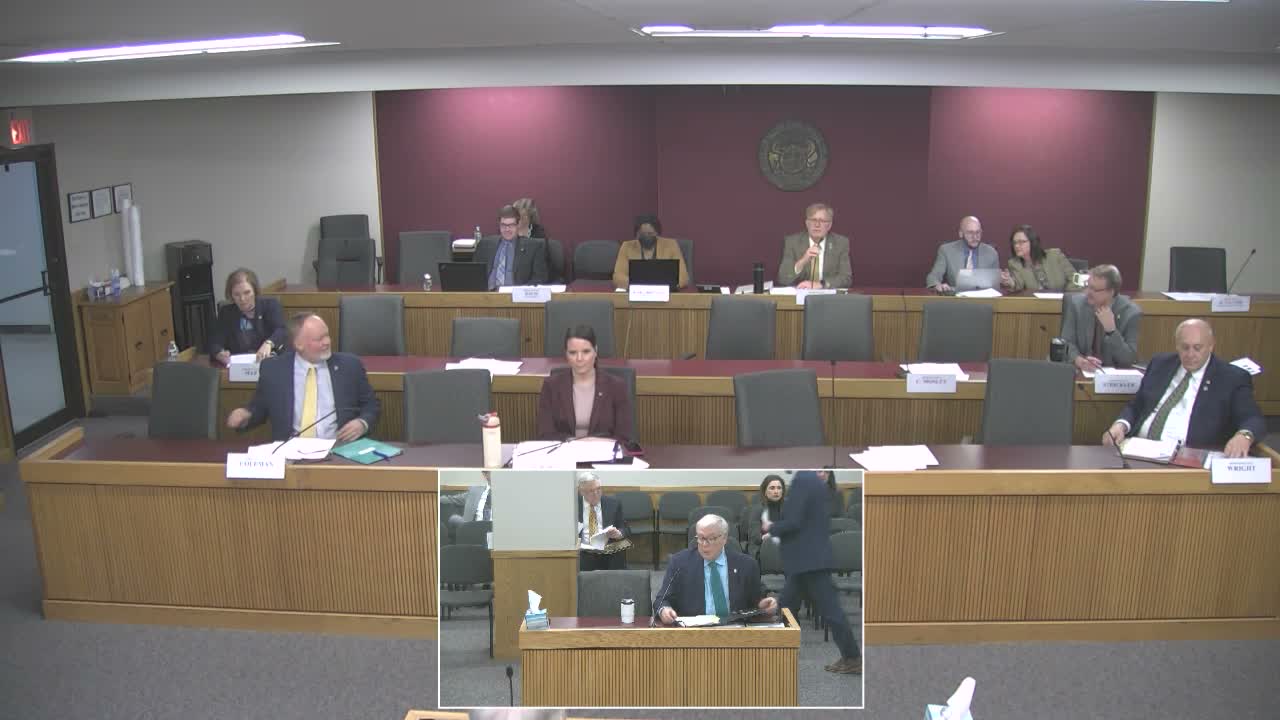
Republican sponsor pitches TABOR-style 'Taxpayer Protection Act' in committee hearing
Loading...
Summary
Representative Jim Murphy introduced HJR 169, a proposed 'Taxpayer Protection Act' modeled on Colorado's TABOR that would cap spending growth to inflation plus population growth, add fees and abatements into the base, provide refund rules, and leave voter approval for tax increases; committee and witnesses probed refund mechanics and emergency exceptions.
Representative Jim Murphy (District 94) told the House Ways and Means Committee he was introducing House Joint Resolution 169, the "Taxpayer Protection Act," which he said would cap government spending at a rate equal to inflation plus population growth and require voter approval for tax increases or spending over that limit. "We'll refer to it throughout the hearing as TABOR," Murphy said when he opened his presentation.
Murphy said the two-page constitutional amendment mirrors the Colorado law from 1992 that he described as the "gold standard," and that he planned an amendment to include fees and surcharges and to add tax abatements back into a jurisdiction's spending base. "If they give the abatement that's fine — I'm going to add that back into their base," Murphy said, arguing the change would discourage competitive abatements that shift costs to other taxpayers.
The bill text sets an effective date of 01/01/2027 and describes a mechanism for refunds if revenues exceed the cap; Murphy acknowledged the legislature or local governments would need to decide the operational details. Committee members pressed the sponsor on specific mechanics: how abatements would affect small cities that rely on abatements to attract retailers; whether the inflation measure would be national CPI (Murphy and staff confirmed use of CPI); and how the refund or rebate process would work locally. Murphy said emergency spending is accounted for but requires a governor's declaration plus supermajorities in both chambers to override limits.
Two witnesses provided in-person or written testimony. Camelia Peterson of Americans for Prosperity said the group "wholeheartedly supports HJR 169," calling it about "trust, transparency, and accountability" and a complement to proposals to eliminate the income tax. Joshua Meyer, director of tax and fiscal policy at the American Legislative Exchange Council (ALEC), gave informational testimony about Colorado's TABOR experience and projected fiscal impacts in Missouri. Meyer said Colorado's TABOR-style refunds were large in recent years, listing $9,400,000,000 refunded to Coloradans from 2021 to 2024 as an example of the refund consequences of a strict cap.
Committee members repeatedly asked for more detail and clarity. Representative Strickler said the bill "is simple in principle" but hard to read and asked for a section-by-section review; he and others requested more clarity on reserve levels, refund procedures, and how the measure would interact with the existing Hancock Amendment. Meyer said a TABOR-style limit would be "stricter" than Hancock and would reset allowable spending using population plus inflation rather than Hancock's personal-income-based growth calculation.
No committee action or vote was taken; the chair closed the hearing and moved to the next agenda item. The committee left open questions — notably the procedural details of refunds, precise definitions that determine which revenue sources are counted, and how local jurisdictions would implement the rebate or refund mechanism — that sponsors and staff said they would clarify in subsequent drafts or informational follow-ups.
Ending: The committee concluded the HJR 169 hearing without a vote and proceeded to the next bill on the agenda.