Get Full Government Meeting Transcripts, Videos, & Alerts Forever!
Get email alerts on the Land Use topic
No spam. Unsubscribe anytime.
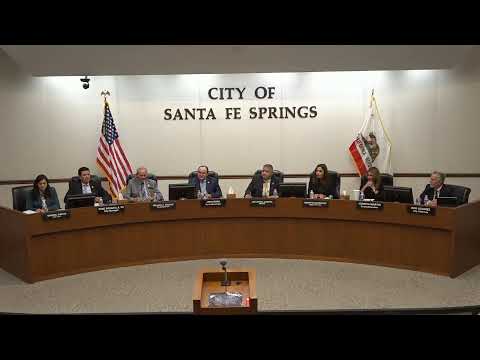
Santa Fe Springs City Council approves first reading of ordinance for proposed U-Haul site
Summary
The City Council approved the first reading of Ordinance No. 1166 to allow a proposed U-Haul facility at a constrained site; staff said the applicant added a retail component that will generate sales tax and the applicant’s representative said no firm opening date is set while approvals proceed.
The Santa Fe Springs City Council approved the first reading of Ordinance No. 1166 on a voice vote after a staff presentation and questions about tax and timing. The ordinance would amend sections of Title 15 (chapter 155) of the Santa Fe Springs Municipal Code; the City Attorney read the ordinance and stated the project is exempt from the California Environmental Quality Act (CEQA).
City staff described the U-Haul proposal as a difficult site adjacent to a railroad with limited access and said the applicant added an on-site retail component to improve the site's viability. “Before you is public hearing for, a new U Haul that's slated to, be placed across the street from the transportation facility,” a staff presenter told the council during the public hearing.
Council members asked whether the project would generate sales tax. Staff replied that the developer included retail space and “there will be a sales tax component to this.” A U‑Haul representative who identified himself only as Robert said the company had no firm timeframe while it completed approvals, noting construction timetables vary; he said some projects take about 12–14 months and that 2027 was a possible target depending on approvals and the build-out.
The public hearing drew no public testimony. Councilmember Rounds moved to advance the ordinance and Councilmember Martin seconded; the council responded with voice votes of "aye" and the mayor declared the item ordered (first reading approved). The transcript records the voice approval but does not include a roll-call-style tally of individual votes.
The ordinance moves to the next required steps for adoption and additional hearings or readings as prescribed by council rules and municipal code.