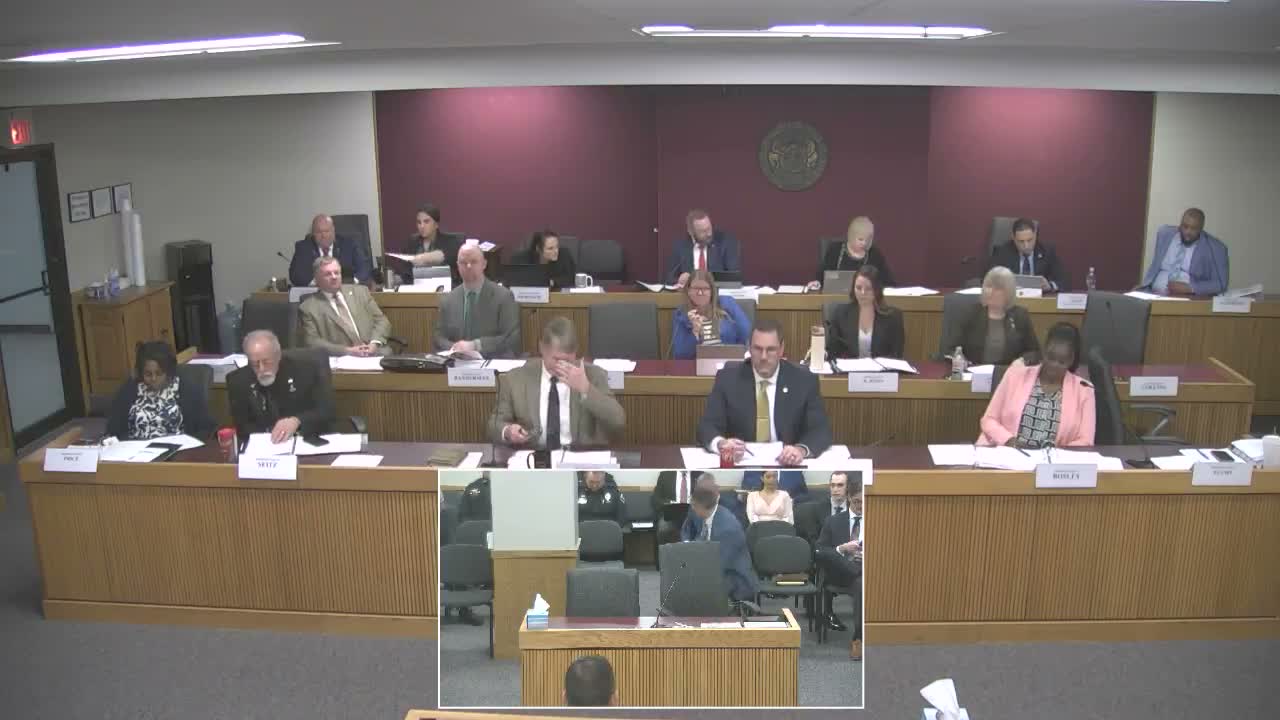
Committee hears bill to give trained officers authority to mitigate dangerous drone activity; members seek clarity on limits
Loading...
Summary
Representative Mike Jones presented HB 25‑87 to align Missouri law with the federal Safe/ Safer Skies Act and allow trained officers to detect, track and mitigate unlawful or dangerous unmanned aircraft; testimony emphasized electronic mitigation over shooting down drones but raised concerns about regulatory clarity and federal rulemaking.
Representative Mike Jones (District 12) introduced House Bill 25‑87, which would update state law governing unmanned aircraft to give trained, authorized law‑enforcement officers powers to detect, track and respond to dangerous drone activity — particularly over large gatherings and critical infrastructure.
"This bill gives trained and authorized law enforcement officers clear legal authority to detect, track, and respond to dangerous or unlawful drone activity while aligning Missouri law with existing federal authority," Jones said, adding that the effort seeks to protect legitimate drone use while permitting mitigation of credible threats.
Members asked how broad the mitigation authorities would be after language describing "necessary mitigation measures" and examples including "jamming, hacking, use of force, or physical force." Representative Sites asked if the language could allow officers to "shoot down an aircraft." Jones and witnesses said most mitigation would be electronic and that training and federal guidance (training through FBI programs and Department of Defense‑released tools) should limit misuse. Lieutenant Alex Bevis of the Missouri State Highway Patrol said the bill "does not expand unlimited authority" and that officers must have articulable facts of criminal activity before taking action.
Opponents and cautious stakeholders underscored remaining ambiguities. Jared Hankinson of the Missouri Chamber of Commerce said the chamber shares public‑safety goals but urged caution because federal rules and training standards remain incomplete, and ambiguous state language could create conflicts with FAA rules. Industry testimony from Jeff Rorta (L3Harris Technologies) described commercial counter‑UAS tools that take control of a device or direct it to land — and emphasized that vendors typically offer electronic takeover rather than a kinetic 'shoot‑down' option.
Members also discussed practical elements: the bill relies on existing RSMO definitions (for example, RSMO 569.086) to define critical infrastructure, it requires signage for certain open‑air or critical facilities, and sets a 400‑foot vertical distance as a reference point tied to FAA limits. Questions remained about whether recreational operators will inadvertently violate the law, how signage would be implemented, and how to ensure citizen protections. The committee concluded the public hearing with multiple law‑enforcement witnesses in favor; no final committee vote on HB 25‑87 is recorded in this transcript.