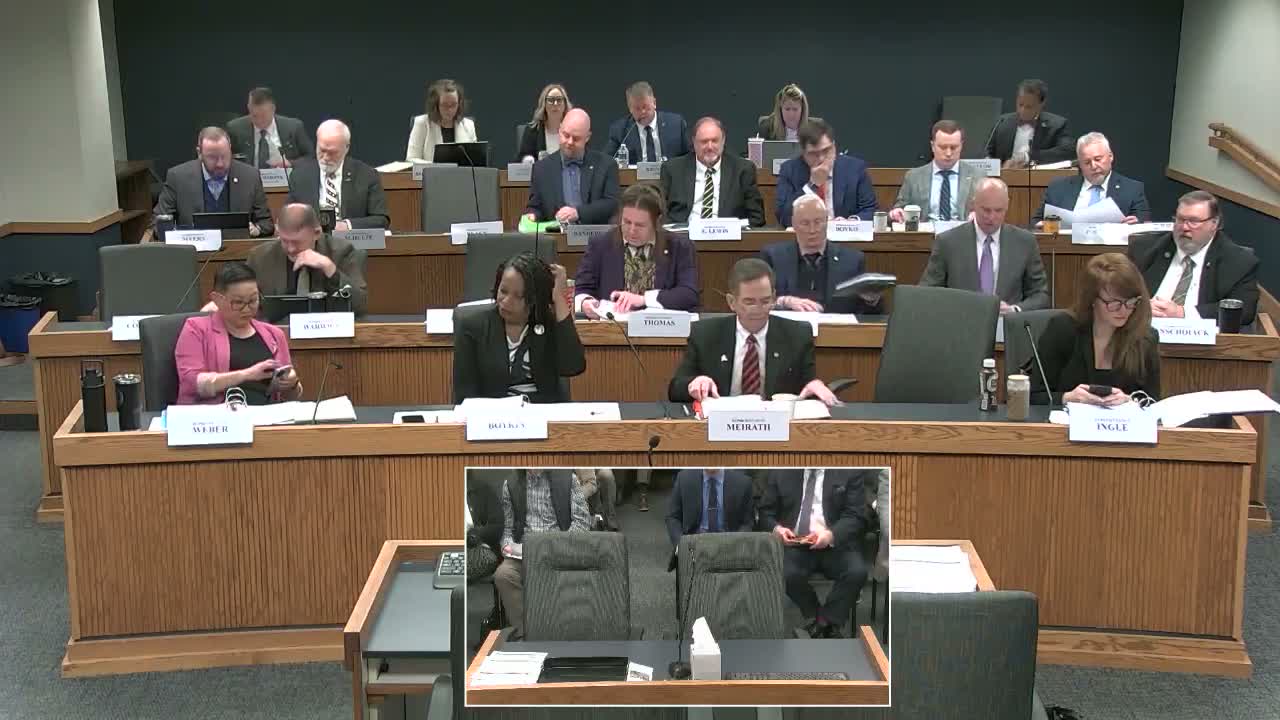
Missouri committee hears broadband tax break bill as industry pushes for seven-year cut
Loading...
Summary
Sponsors and providers told the House Utilities Committee House Bill 27‑11 would lower assessed value on qualifying broadband equipment, from 33.5% to 12%, for new builds in a time-limited window to spur rural deployment. County assessors warned of uneven tax treatment and local revenue loss.
Representative Dane Deel (sponsor) asked the House Utilities Committee to consider House Bill 27‑11 as a tool to encourage broadband investment in lower-density parts of Missouri. "My bill simply lowers the assessed evaluation from 33 and a half percent down to 12%," Deel told the committee, framing the measure as a competitive incentive to attract private infrastructure investment.
Industry witnesses told the committee the change would make otherwise marginal projects more economically feasible. Jeremy Keter, representing AT&T Missouri, told lawmakers the bill "creates a new subclass of tangible personal property for qualifying broadband equipment" and that under the proposed language "the equipment will be assessed at 12% of true value for tax years 2027 through 2033," providing a seven-year sunset intended to push new builds. Scott Swain of Verizon and other carriers testified they consider relative tax rates when deciding where to place upgrades and new equipment.
Supporters argued the policy would not require new state spending and would leverage private capital to expand fiber and wireless infrastructure in rural and high‑cost areas. Derek Leffert of Gateway Fiber and representatives of cooperatives and the Missouri Chamber described the change as an economic development incentive that could steer investment into communities currently considered uneconomic to serve.
County assessors and local officials raised concerns about the proposal's effect on local revenue and whether it would create an untenable carve-out in assessment practice. Kenny Moore, Boone County assessor, told the committee "the Missouri Constitution requires the property must be assessed uniformly and equitably," warning that reclassifying what had been treated as real property into a lower-assessed personal property subclass could conflict with uniformity principles and shift burdens onto other taxpayers.
Members pressed practical questions: whether the measure applies only to new builds or also to upgrades, how assessors and the State Tax Commission would implement the change, and whether the bill should include a legislative sunset. Sponsor and industry witnesses repeatedly emphasized the intent is to make future builds and certain upgrades more viable during a limited period; at least one sponsor-substitute was described as adding a forward-looking 2027–2033 sunset to align with the Senate version.
The committee did not take a final vote on House Bill 27‑11 during the hearing. Chairmen and members asked witnesses to submit written testimony and data, and the committee left room to refine statutory language on assessment definitions and sunset timing.