
Missouri utilities committee hears divided testimony on bills to regulate utility-scale solar
Get AI-powered insights, summaries, and transcripts
Subscribe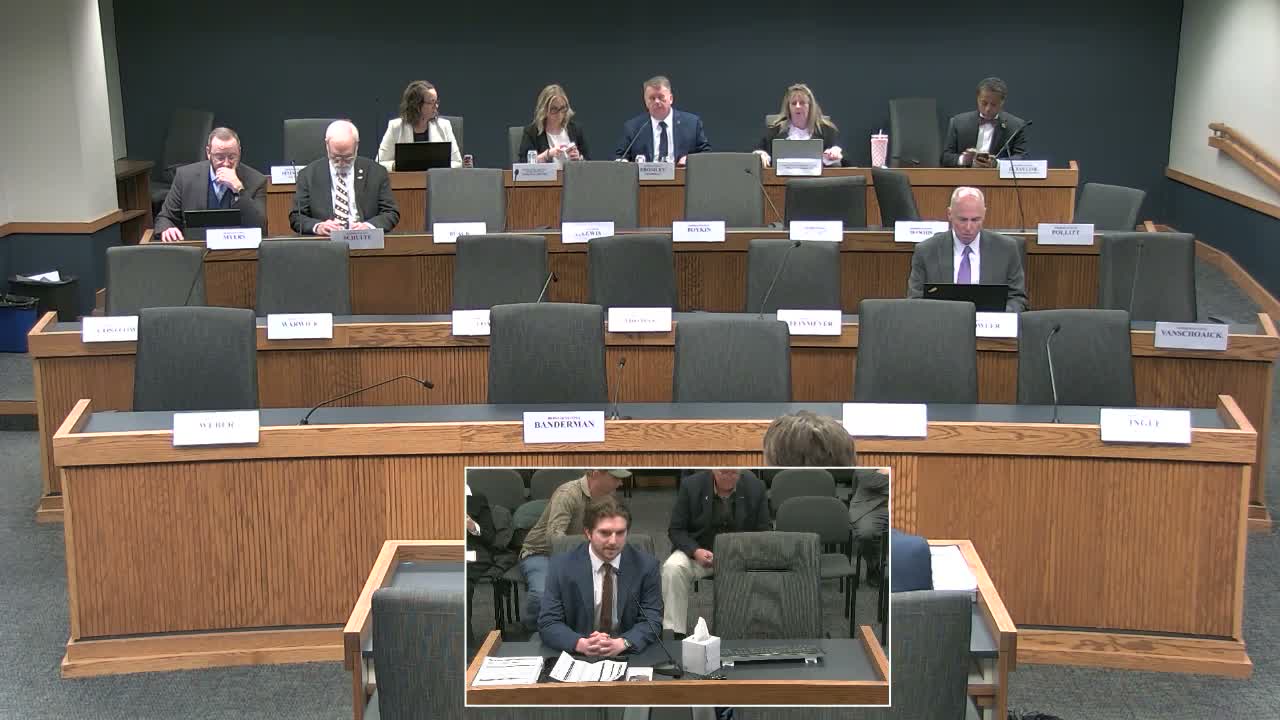
Summary
Lawmakers and witnesses urged changes to House Bill 2816 and House Bill 2402 at a Utilities Committee hearing, debating per‑megawatt taxation, setback distances, caps on conversion of cropland and whether counties should retain regulatory authority.
The Missouri House Utilities Committee heard more than a dozen witnesses weigh in on House Bill 2816 and House Bill 2402, two measures that would set statewide rules for utility‑scale solar projects.
Supporters of the bills told the committee the state needs clear standards for siting and taxation; landowners and county officials urged stronger protections. "I detest Chapter 100," Arnie C. ACDINOV, state public advocate, said near the hearing’s end, arguing for higher taxes and zoning protections for residences, schools and places of worship. The committee adjourned after hearing testimony and did not take a vote.
Why it matters: The bills would affect how utility‑scale solar is taxed and where arrays may be located on agricultural land—issues with real budgetary and local‑planning consequences for rural counties that would host many of the projects.
What witnesses told lawmakers
Tyler Travers, policy director of Renew Missouri, said he appreciates parts of the bills but expressed "hesitancy" about a 500‑foot setback and about reclassifying lands from agricultural to commercial assessment, citing possible conflicts with the 2014 right‑to‑farm amendment. He said he would prefer the smaller 200‑foot setback negotiated in earlier proposals.
Several rural landowners pushed for sharper protections. "I have a 160‑acre Randolph County farm [that] is now surrounded on all sides by at least 2,400 acres under contract for solar panels and battery storage," said Mark Taylor, who urged a higher tax than the bill’s $2,500 per megawatt and recommended a 1,000‑foot setback for fire‑safety and wetlands protection. Taylor also described long contract terms (he cited 40‑ and 50‑year contracts) and said some agreements contained nondisclosure clauses that limited neighbors’ ability to learn project details.
Susan Burns, representing the Mid Missouri Landowners Alliance, urged the committee to raise the per‑megawatt charge and lower a proposed 4% cap on agricultural conversion to 2%, warning of rapid development and citing a survey she said showed "about 88,200 acres" leased or under development for wind and solar in Missouri. Burns urged the committee to consider an emergency clause so rules would apply before July 4, 2026, a date she said could trigger a wave of project starts to secure federal incentives.
Farm advocates and county officials also urged decommissioning requirements and funding to equip local fire departments to handle lithium‑ion battery fires.
Industry and utility perspectives
Waylon Brown, regional policy manager for the Clean Grid Association (representing independent power producers), told the committee that state‑to‑state tax comparisons can be misleading and that the total tax burden often falls in the $2,500–$4,000 per megawatt range when all taxes and incentives are considered. He cautioned lawmakers to examine the aggregate tax impact rather than one single statutory number.
Zac Monroe of Ameren Missouri said most provisions were acceptable to the company but urged care on setback language and assessment mechanics; using the utility’s 2023 integrated resource plan he said solar generation with tax credits can cost "a little over a nickel a kilowatt hour." Ameren also told lawmakers it expects to largely pause new solar builds by about 2032 under its current plans.
Other witnesses including engineers and contractors offered technical input on setbacks, easements, and viewshed mitigation. Several suggested alternatives to long setbacks—such as viewshed rules, negotiated community benefit agreements, and vegetation buffers—that could address neighbor concerns without consuming large amounts of productive farmland.
What lawmakers focused on
Committee members repeatedly pressed witnesses to quantify trade‑offs: how higher per‑megawatt taxes would affect project economics and local tax revenue, and how setbacks or viewshed rules would shift project footprints onto additional acres of cropland. Members emphasized the difficulty of balancing landowner property rights, local governments’ limited planning capacity in some counties, rural emergency‑service limitations, and the state’s broader energy affordability goals.
Next steps
The hearing was informational; the committee did not vote on either bill. Lawmakers signaled they expect to continue refining language on taxation, setbacks, caps on agricultural land conversion, decommissioning and Chapter 100 provisions as the session continues.