
Missouri bill would make fiscal notes estimate staff hours to implement new programs
Get AI-powered insights, summaries, and transcripts
Subscribe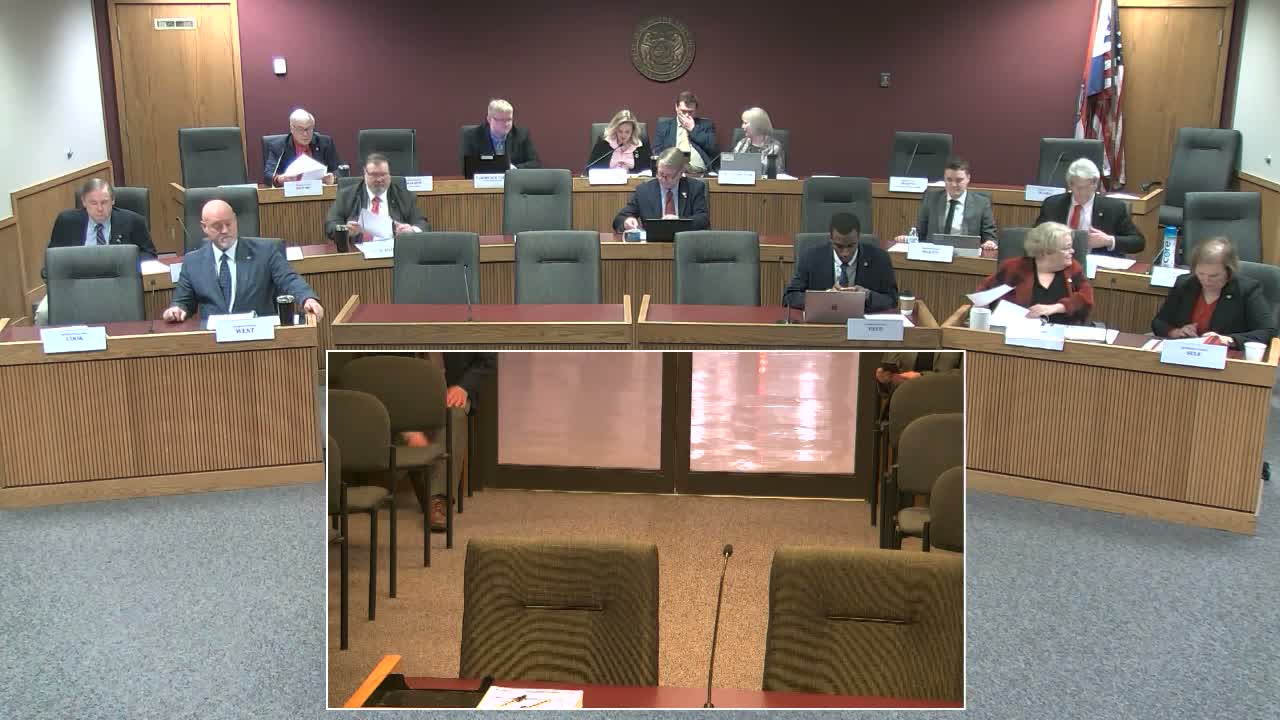
Summary
House Bill 2226, sponsored by Representative Louis Riggs, would require fiscal notes to estimate the employee hours needed to implement new programs. Sponsors say the change would reveal a ‘hidden tax’ of lost productivity; critics question the accuracy and cost of producing those hour estimates.
Representative Louis Riggs introduced House Bill 2226 to the House Committee on Government Efficiency on Feb. 9, 2026, asking that fiscal notes attached to bills include estimates of employee hours needed to implement newly authorized programs. "This bill is as simple as simple gets," Riggs said, adding that fiscal notes should "estimate the employee hours it will take to implement any new programs."
Riggs framed the proposal as a remedy for what he called an uncounted burden on school and agency staff, citing testimony from reading teachers who spent class time conducting mandated assessments. "They were literally sitting at a computer checking boxes… So if we're gonna mandate it, we should at least have a faint notion of how many hours it's going to cost," he said. Riggs called that burden "a tax on productivity."
Members praised the idea in principle while pressing practical questions about implementation. Representative Van Schaoyck said she was "appalled" by the fiscal note attached to the bill, which she read as projecting roughly $260,000 by year three to produce the estimates. "I can't understand how asking that they estimate the employee hours required to employ a new program is going to cost upwards of…$260,000 a year by year 3," she said.
Other members pressed whether agencies can provide meaningful hour estimates before a bill's final text is settled. Riggs responded that agencies routinely estimate implementation costs and could gather frontline input—superintendents and teachers—to quantify hours, then convert those hours into a dollar figure if desired. "You can estimate it," Riggs said; "they often do."
Representative Steinmetz, speaking from his experience as a reading specialist, said testing students individually does take substantial time and that the bill would help surface the operational consequences of legislative mandates. Supporters suggested the bill would provide lawmakers more evidence when considering mandates that shift work to schools or local agencies.
The committee heard no public witnesses on HB 2226, concluded the hearing, and did not take a vote during the Feb. 9 meeting. The sponsor said he is open to amending the bill to add clarifying language tying hours to bill summaries and bill numbers.