
FDA lab reports electrical stimulation can substantially reduce early nontuberculous mycobacterial biofilms in lab tests
Get AI-powered insights, summaries, and transcripts
Subscribe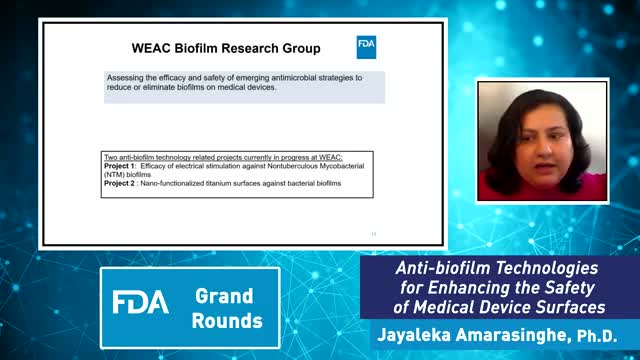
Summary
Researchers at the FDA's Winchester Engineering and Analytical Center report that cathodic electrical current eliminated early Mycobacterium chimaera biofilms in laboratory tests but fell short of the FDA's 3‑log intermediate‑level disinfection threshold for some conditions; mature biofilms remained more resistant.
Dr. Jelika Amarsingh, a microbiologist at the Winchester Engineering and Analytical Center (WEAC), reported laboratory evidence that cathodic electrical stimulation can disrupt early nontuberculous mycobacterial (NTM) biofilms on stainless‑steel medical‑device surfaces. The work, presented at FDA Grand Rounds, tested Mycobacterium chimaera biofilms grown on coupons and measured viability by colony counts and live/dead fluorescence staining.
The study used two electrochemical approaches. In an initial test, Amarsingh said applying −1.8 volts for one hour to one‑day M. chimaera biofilms produced “about 1.5 log reduction in viable … bacteria. This is equivalent to about approximately 96% reduction of the viability compared to the untreated control.” She noted that result, while measurable, “falls short of the 3 log reduction threshold generally considered by the FDA for intermediate level for mycobacteria.”
Stronger effects were observed when current (rather than just voltage) was delivered. According to Amarsingh, a cathodic current density of −1 ampere per square centimeter reduced planktonic NTM rapidly and “by 30 minutes, we were able to completely eliminate this bacteria by 30 minutes of treatment with minus 1 amp current density stimulation compared to the untreated control.” In the same protocol, 40 minutes of −1 A/cm² eliminated one‑day biofilms in their chamber tests.
When the team repeated the experiment on one‑week (more mature) M. chimaera biofilms, effects were reduced: Amarsingh reported about a 2‑log reduction in biofilm‑associated viable cells after 40 minutes at −1 A/cm². She attributed the lower efficacy to development of a thicker extracellular polymeric substance (EPS) matrix that limits electrochemical penetration, and said that maturity strongly influences treatment success.
Microscopy using SYTO 9 and propidium iodide live/dead staining supported the colony‑count data: electrical treatment samples showed markedly reduced green (live) signal compared with controls for early biofilms, though not all viable cells were removed in every replicate.
Amarsingh emphasized limitations and next steps. The experiments were laboratory‑scale and used a controlled three‑electrode chamber with PBS; the results do not establish safety or efficacy in clinical settings. She noted planned follow‑up work to test combined strategies, longer exposures, corrosion impacts on stainless steel, and translational studies under realistic contamination and reprocessing scenarios.
The presentation frames electrical stimulation as a promising non‑antibiotic, surface‑targeted approach that may reduce device contamination risk if validated and integrated into a performance‑based regulatory framework.