Get Full Government Meeting Transcripts, Videos, & Alerts Forever!
Get email alerts on the Industrial Development topic
No spam. Unsubscribe anytime.
Council deadlocks on Reconstruct Aggregates wet-processing permit after residents raise pollution and truck concerns
Summary
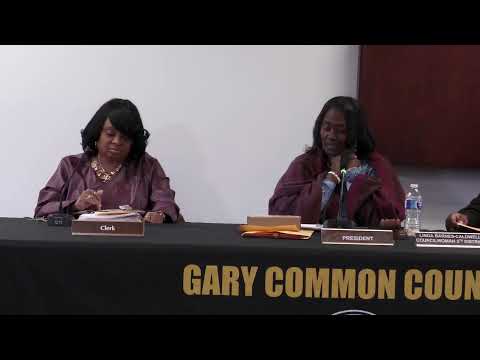
After hours of public comment and a company presentation, the Gary Common Council tied 4–4 on CPO 2025-74, rejecting a special-use permit for Reconstruct Aggregates to operate a wet soil-processing plant at 4900–5200 E. 15th Ave amid questions about testing, truck routes and decommissioning assurances.
A proposed wet-processing facility from Reconstruct Aggregates failed to win council approval on Feb. 3 after intense public opposition and detailed questioning from council members and residents. The motion for CPO 2025-74 resulted in a 4–4 roll call and was recorded as failing.
The petitioner’s counsel and company representative (Scott Yaney and Darren Eastwood) presented the technology as a dust-free, electrically driven washing plant intended to process clean (inert) soils into reusable construction aggregates. Eastwood said the company anticipates roughly 100–125 truck trips per day, expects to employ about 15 full-time workers and will accept only clean soils without waste manifests. He said that contaminated loads would be subject to waste manifests and would not be accepted under the proposed permit.
Residents and neighborhood advocates – including members of local community groups and nearby homeowners – urged the council to deny the permit or delay action until additional protections were in place. Speakers asked for complete disclosure of who was notified about the project, a traffic study that assesses 100+ trucks per day on 15th and Clay and surrounding residential streets, site testing protocols for inbound soils, a cap on onsite stockpiles, and a performance/decommissioning bond to protect the city if the business fails.
Council members pressed the petitioner on several fronts: how “clean” soils would be certified, whether the company could require truckers to avoid Clay Street, how much material would be stored on site, and whether a bond could be required to ensure decommissioning. The petitioner acknowledged that it does not control third-party trucking companies and that certification initially relies on the transporter’s declaration; he said contaminated loads would require manifests and different handling.
Why it matters: Neighbors said the Aetna and Edmond Manor communities already suffer heavy truck traffic and air quality concerns; the petitioner argued the facility recycles material that otherwise would be hauled long distances, reducing road miles and CO2. The council’s tie vote leaves the zoning in its current state; because approval requires a majority, the ordinance failed.
Vote and next steps: The roll call returned a 4–4 split (recorded as 4 yes, 4 no). Because the motion did not receive a majority, CPO 2025-74 failed and the petitioner will need to decide whether to revise the application, provide the additional guarantees requested by residents, or pursue other administrative paths.