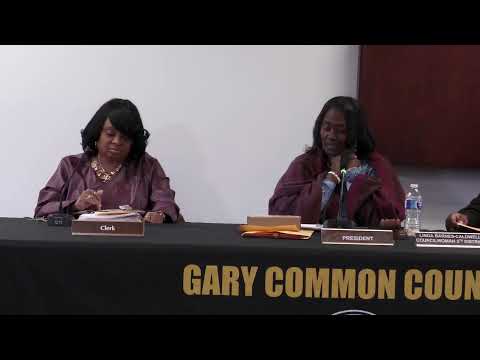
Gary council approves short-term rental at 8720 Oak Avenue with nine conditions
Loading...
Summary
The Gary Common Council voted 6–2 to approve a special-use permit allowing a non-owner-occupied short-term rental at 8720 Oak Ave, adopting nine conditions including occupancy limits, parking requirements and annual review with potential revocation after repeated verified violations.
The Gary Common Council on Feb. 3 approved a special-use permit allowing a non-owner-occupied short-term rental at 8720 Oak Avenue, voting 6–2 after a lengthy public comment period in which neighbors urged denial and supporters highlighted local economic benefits.
Attorney for the planning department, who summarized the proposal on the council floor, said the ordinance before the council was an amended version that attached nine conditions to the permit. Those conditions include obtaining and maintaining a City of Gary business license for short-term rental use, limiting occupancy to two adults per legal bedroom, requiring one off-street parking space per rented room, requiring quiet hours from 10 p.m. to 7 a.m., an annual review that permits revocation after multiple verified complaints, and a requirement that a 24-hour local contact be listed with the city and neighbors.
Why it matters: The ordinance sets a detailed local framework for homeowner-run short-term rentals while signaling the council’s effort to balance tourism-related revenue with neighborhood quality-of-life concerns. Opponents said the Oak Avenue block is a narrow, elderly-populated alley where additional cars, noise and trash would harm the community. Supporters and the petitioner’s co-hosts said the unit will be treated as a family home managed locally and that rules and perimeter cameras will be used to enforce occupancy and quiet hours.
What council members said: During debate Councilwoman Latham said the council’s hands are constrained by state law but praised the nine added conditions as a way to preserve neighborhood safety. Another council member warned that denying a lawful application could expose the city to legal challenges under state statutory standards for special uses. Several members emphasized enforcement mechanisms, including ordinance violations that could trigger revocation under local procedures that track with state statute.
Vote and next steps: The roll-call vote recorded Councilman Halliburton, Councilwoman Ivy, Councilwoman Latham, Councilman Tolliver and Councilman Williams as voting “yes,” and President Caldwell and one Councilman Washington as “no” (the transcript records two council members listed as “Councilman Washington”; the roll call recorded one as voting “no” and one as “yes”). With a 6–2 tally, CPO 2026-01 passed on third reading. The ordinance is now in effect under the terms stated; enforcement will be handled by the city’s planning and zoning and code-enforcement staff, and the permit is subject to annual review.