
Ulster County advances mixed‑waste processing deal, weighing anaerobic digester, compost expansion
Get AI-powered insights, summaries, and transcripts
Subscribe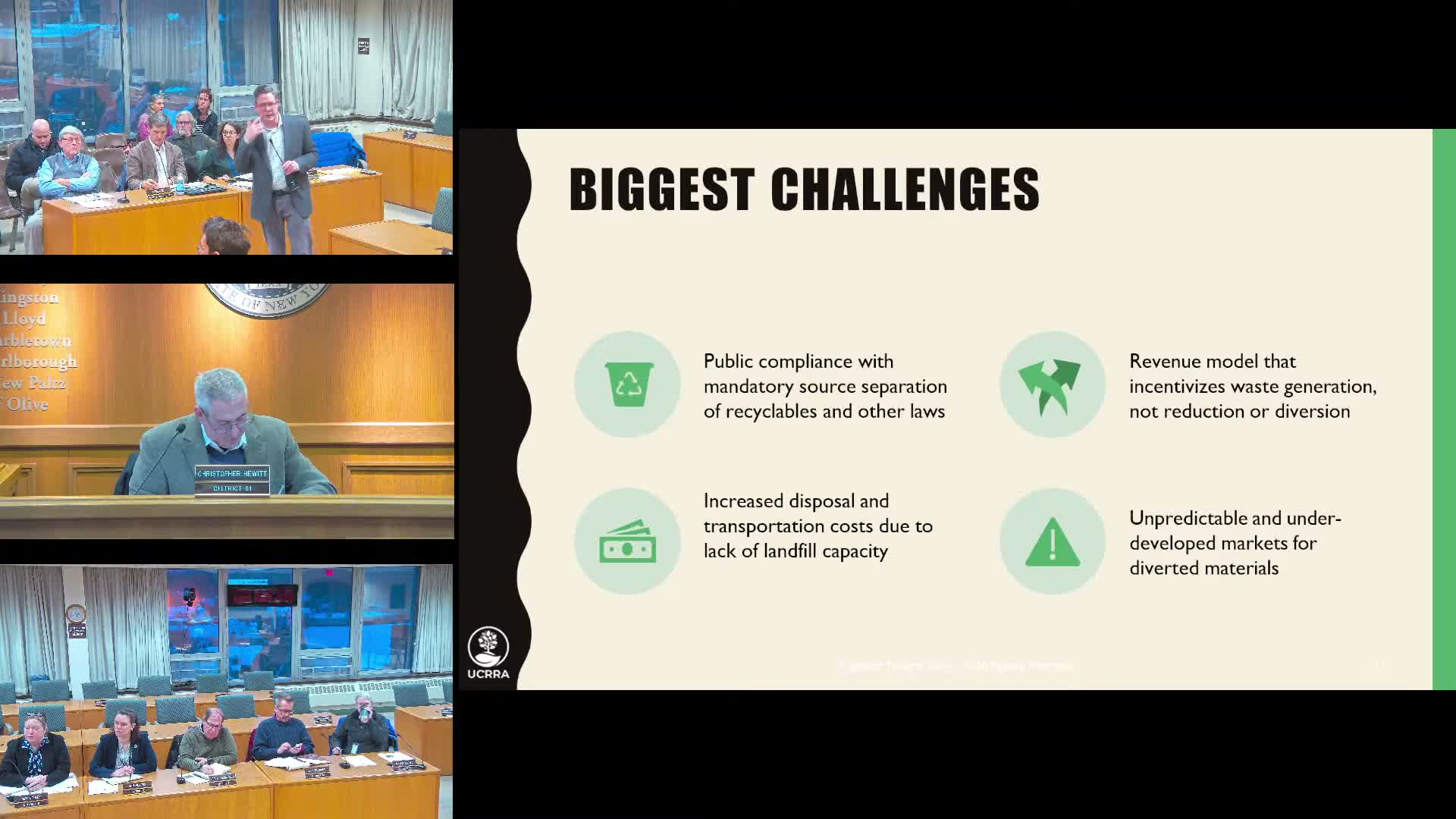
Summary
County waste director outlined a portfolio of projects — mattress recycling, town‑hub reuse (Repower), compost expansion and an RFP award to Global NRG for a mixed‑waste facility — saying the system could divert up to 20% as recyclables and process organics through thermal hydrolysis and anaerobic digestion; officials answered questions about costs, PFAS risk and feedstock agreements.
Ulster County’s waste agency presented an update on its 10‑year solid waste management plan and steps to reduce landfill reliance, including a recently awarded contract to Global NRG to build a mixed‑waste processing facility and anaerobic digester.
Director Ryder told the committee the county relies heavily on tipping fees and faces shrinking landfill capacity in New York, with Seneca Meadows currently the most practical disposal site at about 250 miles away. Ryder warned that at the current rate — “our state sends waste to landfills, which is about 9,000,000 a year” — in‑state landfill capacity could be exhausted by 2043 without intervention.
Why it matters: Ryder framed the Global NRG project as a way to reduce long hauls and landfill dependence while recovering materials and producing renewable gas. He said the mixed‑waste plant would separate roughly 20% of incoming municipal solid waste as regulated recyclables and route the remaining ~80% to thermal hydrolysis and anaerobic digestion to produce renewable natural gas and a digestate.
Ryder described complementary initiatives underway: a mattress‑recycling contract bringing textile and insulation reuse, a Repower “spoke‑and‑hub” reuse project aimed at diverting roughly 5,000 units of material via town transfer‑station collection, and composting expansion (county permitted capacity increased from 5,000 to 7,500 tons, with a stated long‑term goal to reach 10,000 tons).
Costs and contract structure: When asked how the county will pay for the plant, Ryder said Global NRG would finance construction and the county would enter a long‑term feedstock agreement committing the county’s waste stream. Ryder gave a contractor range he had seen: “between a 100 and a $150,000,000” depending on technology and site conditions, and said the county is working with the company to reduce the per‑ton cost in the feedstock agreement.
On feedstock and PFAS: Committee members and public questioners raised whether sewage sludge would be included. Ryder said that is under clarification with the company and noted existing practice: the county sends approximately 3,000 tons of sewage sludge to Rockland County for composting and land application. Ryder flagged PFAS and other contaminants as an issue the county has asked Global NRG to address and said the company has committed that, if digestate cannot be land‑applied due to quality concerns, it will be used as an alternative beneficial cover at a landfill without extra financial obligation to the county.
Projected diversion and timeline: Ryder said the project would materially accelerate diversion targets if implemented, and cited the county’s self‑reported diversion data as near “sub‑30%,” acknowledging reporting limitations and plans to improve data collection. He estimated the anaerobic digester could ultimately receive about 50% of the county’s waste stream under the current model.
Public comment and energy use: Resident Kathy Puffer asked whether methane would be upgraded to biomethane for electricity or pipeline use; Ryder replied the plan is to treat the gas and feed it into a utility pipeline.
What’s next: Ryder said the RFP award triggers a six‑month due‑diligence and contract negotiation period and a parallel six‑month stakeholder and public feedback window; the county will continue town‑by‑town outreach and return with more detailed cost and operational terms as negotiations proceed.
Ending: Committee members pressed on cost, timelines and environmental testing; Ryder said staff will circulate impact and outreach reports and follow up on technical clarifications as the Global NRG process advances.