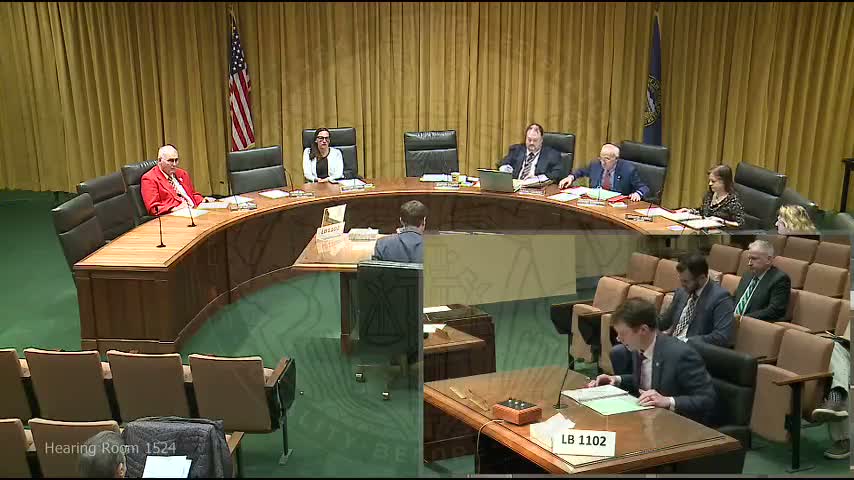
Chair Ballard introduces bill to align OSERS payment and COLA dates with school plan
Loading...
Summary
LB1102 would change how the Omaha School Employees Retirement System (OSERS) calculates and pays COLAs and monthly annuities—moving COLA calculations to Sept. 1 and payments to the last business day of September, setting monthly annuity payments to the last business day, and aligning the retirement-date definition with the school plan; proponents said the bill corrects a 2025 delay and improves administration.
Chair Beau Ballard told the Nebraska Retirement Systems Committee that LB1102 is intended to align the Omaha School Employees Retirement System (OSERS) with the statewide school retirement plan after administration of OSERS moved to the state's retirement system.
Under the proposal, both the annual and medical cost‑of‑living adjustments would be calculated on Sept. 1 and paid on the last business day of September; monthly annuity payments for OSERS would be moved to the last business day of each month; and the statute's definition of "retirement date" would be amended to mirror the school plan rather than delegating to the Public Employees Retirement Board.
"LB1102 makes three essential changes in the way that OSERS pays benefits to the OSERS retirees," said Roger Ray, a former OSERS trustee and plan member, who testified as a proponent. Ray and other supporters said the changes would correct a January 2025 delay in cost‑of‑living payments that resulted from differing statutory interpretations and administrative transition when OSERS moved from Omaha Public Schools to the state system.
Tim Royers, president of the Nebraska State Education Association, testified the alignment would rectify the 2025 delay, simplify operations for NPERS, and better serve retirees. Royers cited an actuarial estimate that the timing change would result in a net increase of about $444,000 in additional district contributions but argued that other actuarial adjustments under consideration could more than offset that amount.
Tyler Cummings, interim director for the Nebraska Public Employees Retirement Systems, gave neutral testimony explaining implementation details. Cummings said NPERS can process COLAs on Sept. 1 and that consolidating notifications for annual and medical COLAs would reduce administrative cost—he estimated roughly $5,000 in annual savings—and simplify communications to members.
During committee questioning, Sen. Carol Conrad raised concerns about policy consistency and equity between actions protecting retiree adjustments and other measures affecting low‑wage workers; Ballard and Conrad exchanged views about how fixed COLA formulas compare with broader inflation measures and recent votes on wage policy.
The committee closed the hearing on LB1102 without a vote; proponents and NPERS staff said the measure addresses an administrative problem and would bring OSERS procedures into alignment with other plans administered by the state.