
Committee debate over LB1259 pits economic development proponents against public‑power defenders
Get AI-powered insights, summaries, and transcripts
Subscribe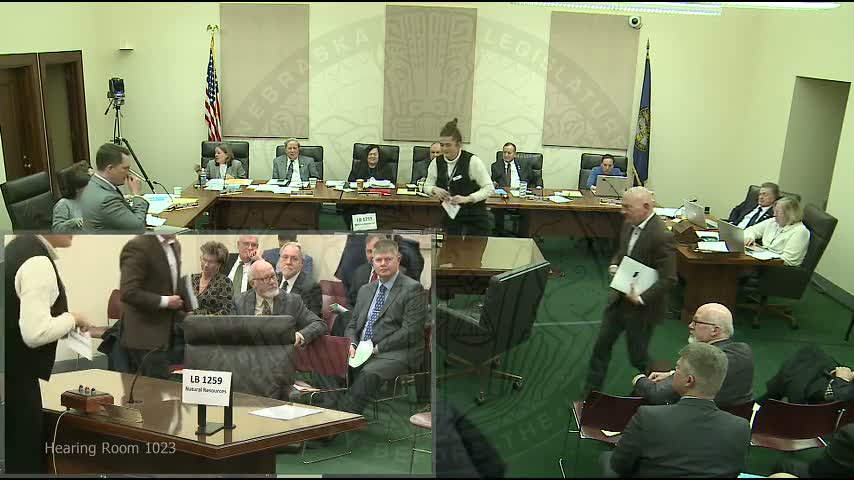
Summary
LB1259 (Grid Modernization Act) would enable behind‑the‑meter generation for very large customers and give the Power Review Board oversight of large‑load contracts; industry proponents said it would attract data centers and rural investment while public power leaders warned it threatens Nebraska's public‑power model and could shift costs to other ratepayers.
Lincoln — The Natural Resources Committee heard LB1259, the Grid Modernization Act, which would create a framework for "behind‑the‑meter" generation and a Power Review Board review process for large load and private generation contracts.
Sponsor Senator Ben Hansen (LD 16) said the bill is designed to keep Nebraska competitive for very large electrical loads — data centers, advanced manufacturing and other high‑consumption industries — by allowing private or customer‑sited generation of 100 megawatts or more and clarifying how utilities and the Power Review Board would review such arrangements. "This flexibility allows Nebraska to secure new business opportunities without compromising public oversight or system reliability," Hansen said.
Industry proponents said behind‑the‑meter generation reduces the need for costly transmission upgrades, improves local resilience and can bring jobs and tax base to rural areas. Michael Westhoff, who said his firm builds data centers, described projects that combine solar, battery storage and combined‑cycle natural gas generation to serve large loads and said Nebraska risks being "closed for business" without such options.
Public power leaders offered strong opposition. Emeka Anyau, chief executive of Lincoln Electric System, called the proposal misleading in its title and warned it "introduces a model designed to invite private for‑profit providers" that could cherry‑pick profitable customers and avoid contributing to shared grid stewardship. John McClure of Nebraska Public Power District said the measure "turns that upside down" with respect to Nebraska's certified retail‑service areas and would expand the Power Review Board’s role into areas like rate setting.
The Nebraska Power Review Board (Tim Texel) testified neutrally but warned of technical gaps in definitions, the difficulty and cost of procuring specialized consultants to perform transmission cost‑allocation work, and a tight timeline in the bill for drafting regulations. Hansen and supporters said safeguards can be added and that the bill attempts to preserve local public power while clarifying routes for large customers to site generation.
The fiscal note and committee discussion flagged consultant costs: the sponsor referenced a $75,000 consultant figure in one line of discussion and committee documents show an estimated annual cost for the Board to retain highly specialized consultants (the Power Review Board estimated roughly $420,000) to implement cost‑allocation and tariff work. The committee closed the hearing after multiple public and utility witnesses spoke; online testimony was recorded as "0 proponents, 12 opponents, 0 neutral" at the time staff read the record.