Get Full Government Meeting Transcripts, Videos, & Alerts Forever!
Get email alerts on the Local Government topic
No spam. Unsubscribe anytime.
Centerville council approves two ordinances amid debate over minutes policy and appointments
Summary
At its Feb. 3 meeting, the Centerville City Council rezoned about 0.5 acres at 2000 N / 400 W to Agricultural Low and adopted municipal-code changes to match the state LUDMA renumbering. The council also debated whether written public handouts should be attached to meeting minutes, approved three appointments and voted to enter closed session.
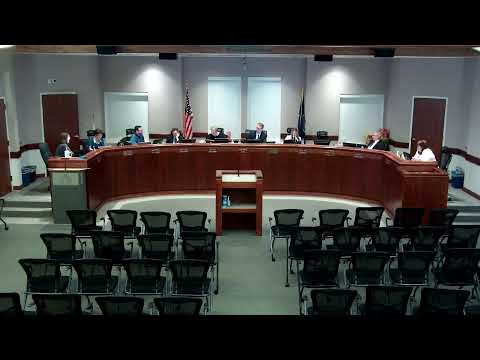
The Centerville City Council on Feb. 3 approved two ordinances updating local zoning and municipal code references and spent an extended portion of the meeting debating whether written public handouts should be attached to official minutes.
The meeting opened with public comment from resident John Urie, who urged passage of a water-wise landscaping ordinance and warned that "our lake is considered in a serious adverse effects zone," citing what he described as long-term shifts in regional water use and urging incentives tied to state rebates for plant coverage and trees.
Staff later presented a zoning map amendment from Residential Low to Agriculture Low for a roughly 0.5-acre parcel (parcel number 070720115) at approximately 2000 North and 400 West. Planner Sydney said the Planning Commission held a public hearing on Jan. 28 and recommended approval 5-0. A council member moved to approve Ordinance 2026-02 to rezone the parcel, with a correction to the staff finding to read "Neighborhood 4" rather than "Neighborhood 3." The council adopted the ordinance by voice vote; the staff record notes the applicant is Spencer Packer.
The council also considered Ordinance 2026-01, a set of municipal code changes to update cross-references to reflect the state Legislature's renumbering of the Utah Land Use Development and Management Act (LUDMA). As staff explained, the Legislature adopted Senate Bill 1008 late last year, which moves previously familiar citations from Title 10, Chapter 9A into Titles 10, Chapters 20 and 21. Council members asked staff to correct a typographical cross-reference (citations discussed in the meeting included CMC 3.08.070 and related entries). After a brief discussion the council unanimously approved the ordinance to align local code citations with the LUDMA changes.
A long discussion followed about whether short written materials distributed during open session should be attached verbatim to the official meeting minutes. Citing the Utah Open Meetings Act as recorded in the meeting (quoted there as "52-4-203") and Centerville City Municipal Code 30.06(g), one council member argued that "any other information that is a record of the proceedings" may be placed in minutes at a member's request. Other members expressed concern that attaching verbatim handouts would undermine the minutes' role as a concise summary and could create a practicability or due-process problem if substantial written submissions were added after public hearings had closed. The council voted to approve the Jan. 6, 2026, minutes as amended to include a short statement reflecting written comments from tree-board chair Heather Taylor; the body discussed establishing clearer policy going forward.
The mayor presented three appointments for council advice and consent: Jacqueline Black to the Trails Committee, Brooke Johnson to the Parks and Recreation Committee and Michael Adamson to the Planning Commission (to fill a vacancy). The council approved the appointments by voice vote.
Council members also used their reports to flag legislative items for staff monitoring and potential outreach, including Senate Bill 219 (a measure members said could affect local billboard siting and height rules), House Bill 161 (relating to primary-residence assessment percentages) and other measures before the state Legislature.
Before adjourning to closed session, a council member moved, seconded and the council approved entering a closed session to discuss the character and competency of an individual.
What happens next: staff will finalize the corrected ordinances and post updated municipal-code citations; council members requested staff develop clearer guidance on when written public submissions should be attached to minutes or otherwise entered into the public record.