Get Full Government Meeting Transcripts, Videos, & Alerts Forever!
Get email alerts on the Impact Fees topic
No spam. Unsubscribe anytime.
The Colony sets roadway impact fee at 90% of maximum, drainage at 100% after public hearing
Summary
After a consultant presentation, the City Council voted to set roadway impact-fee collection at 90% of the calculated maximum and drainage at 100%, citing construction-cost increases, completed drainage projects and 10-year growth estimates.
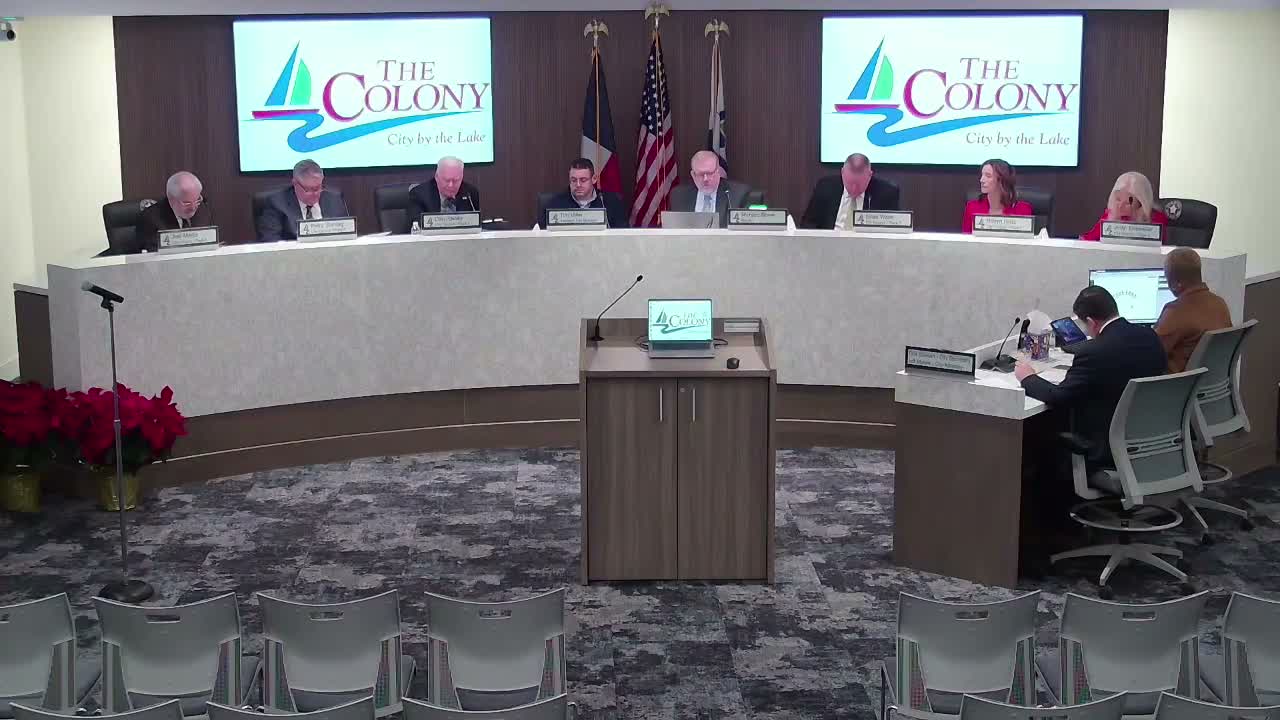
The Colony City Council voted to set the roadway impact-fee collection rate at 90% of the calculated maximum and the drainage fee at 100% following a consultant presentation and public hearing.
Consultants from Kimberly Horn/Horner and Associates told the council the update uses 10-year growth assumptions, the city’s adopted thoroughfare plan and a capital improvements plan to calculate maximum fees. Lead presenter Mason Schofe said the roadway maximum rose from $236 per vehicle-mile in 2016 to $1,052 this year, largely because construction costs “have gone up tremendously.” He noted the firm projects about 875 dwelling units and roughly 850,000 square feet of nonresidential growth in the roadway service area over the next 10 years and 55 acres of added impervious area in the Office Creek drainage watershed.
The consultants recommended collection rates up to 100% of the calculated maximum. Council member Mister Schrag moved to adopt 90% for the roadway fee and 100% for the drainage fee; Mister Wade seconded the motion and the council approved it. The consultants had provided the illustrative 90% roadway figure as roughly $947 per vehicle-mile and the drainage maximum at about $154.80 per service unit.
The presentation explained that the roadway service area follows the state’s 6-mile trip-length limit and focuses on the area around State Highway 121 where much of the projected growth and needed capacity improvements are concentrated. For drainage, consultants said 18 projects were identified in the Office Creek watershed, 15 of which have already been constructed, leaving three remaining projects such as detention outfalls upstream of Blair Oaks Drive and upgrades along Page Road.
Consultants described how impact fees are calculated: identify projects in an adopted plan, estimate construction costs, divide total cost by projected growth (vehicle-miles for roadway, impervious-area service units for drainage) and thereby set a maximum assessable fee. Examples provided in the presentation included an illustrative single-family home roadway maximum near $3,956 if the city charged 100% of the maximum and a hypothetical large retail development facing six‑figure roadway assessments at the full maximum.
Council opened and closed the public hearing with no members of the public speaking. The council directed staff to set the collection rates as motioned; the item passed on the council vote recorded in the meeting.