Get Full Government Meeting Transcripts, Videos, & Alerts Forever!
Get email alerts on the Environmental Health topic
No spam. Unsubscribe anytime.
Caroline County reviews environmental‑health fee schedule; staff to combine fees rather than raise rates for now
Summary
Health Officer Robin Cahall and Maryland Department of Health staff reviewed proposed environmental‑health fee changes, including an 'all‑in‑one' residential evaluation fee and stronger wet‑season testing requirements under MDE/COMAR. Commissioners asked staff to return with a combined fee schedule and to defer increases pending FY27 budget information.
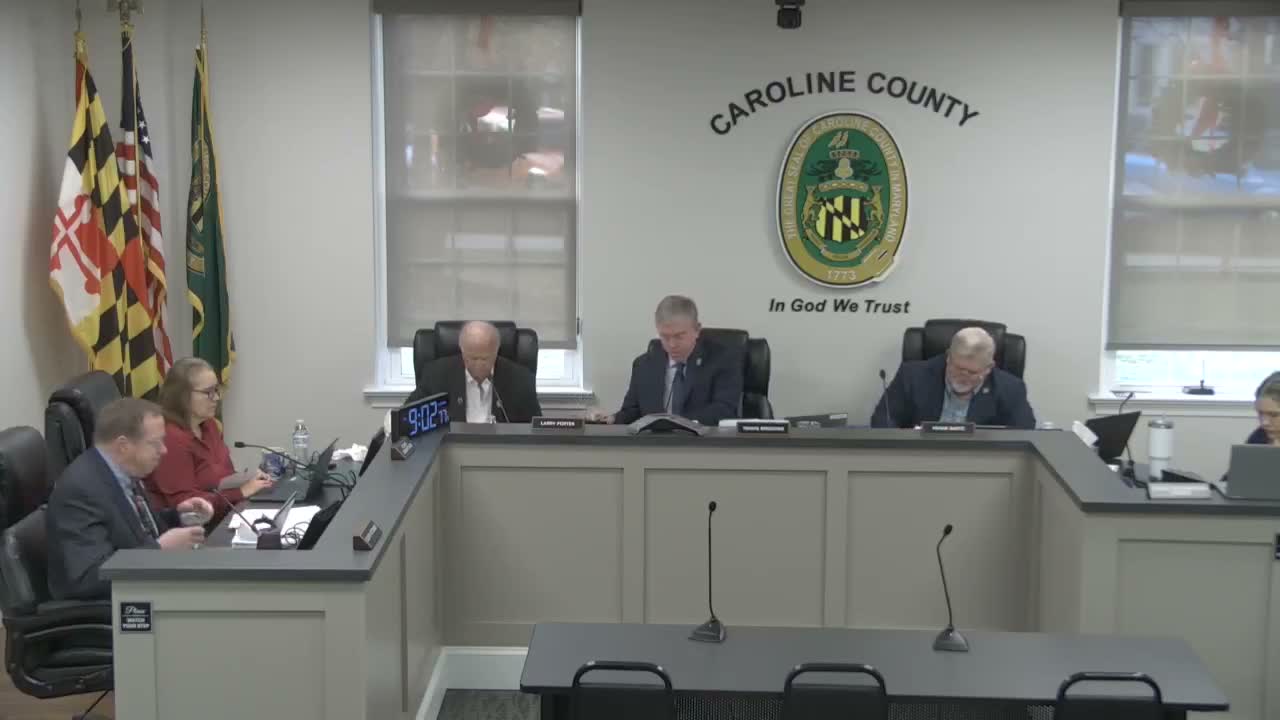
Caroline County commissioners on Dec. 9 heard an extended review of proposed changes to the county’s environmental‑health fee schedule from Health Officer Robin Cahall and representatives of the Maryland Department of Health.
Staff said the county has not comprehensively updated its fee schedule since 2005 and presented a package that would combine multiple steps of a residential soil and site evaluation — soils testing, wet‑season monitoring and (where appropriate) mound testing — into an upfront "all‑in‑one" fee. County staff said the change is intended to streamline processing, reduce repeated customer visits and shorten turnaround time for applicants.
Commissioners and staff also discussed recent enforcement and auditing guidance from the Maryland Department of the Environment and the practical effect of COMAR (state regulations). Staff said MDE is now treating wet‑season groundwater monitoring as necessary for a complete evaluation in many cases; without water‑table results, records can be audited as incomplete. Staff noted that implementation has varied across counties, and that wet‑season monitoring capacity leads to long waits: staff estimated 6 to 18 months for evaluations, depending on application timing and weather.
On workload and outcomes, staff reported that in FY25 the health office received 22 soil/site evaluation applications that produced 24 test sites: 1 was canceled, 6 were approved, 3 were listed as "unacceptable" with sand‑mound options, and 14 required further evaluation. Commissioners said that, given the small annual volume, raising fees might not generate significant revenue but could unfairly burden homeowners.
Staff proposed several operational changes beyond fee consolidation: adopting an after‑the‑fact penalty for unpermitted septic work (proposed to match code enforcement practice elsewhere), adding resubmittal fees to discourage repeated incomplete applications, removing a separate credit‑card processing surcharge (staff said the payment vendor passes processing costs directly to customers), and making permit‑fee waivers available by discretion for county departments.
After discussion, commissioners directed staff to return with a revised fee schedule that combines fees where appropriate, excludes proposed increases for now, and reflects more precise FY27 budget projections before any final votes. Staff will continue coordination with MDE and prepare a supplemental presentation with consolidated numbers.