Virginia Retirement System reports improved returns, outlines hybrid plan options to boost member savings
Loading...
Summary
VRS director Trish Bishop told a House appropriations subcommittee that strong investment returns and prior state infusions have improved funded status, but about $15.1 billion in unfunded liabilities remain; she described steps — including auto‑escalation and a possible shift from 4/1 to 3/2 contribution allocation — to improve hybrid plan outcomes.
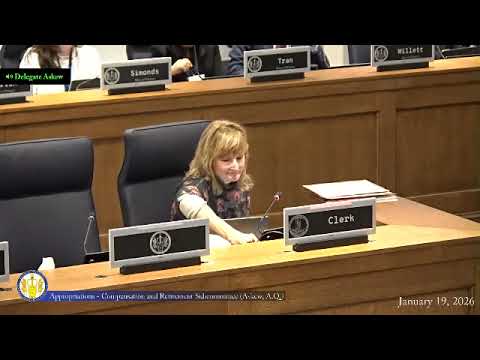
Trish Bishop, director of the Virginia Retirement System, told the House appropriations subcommittee on Feb. 9 that the pension fund had a strong investment year and that policy choices and funding actions have improved plan health, while significant unfunded liabilities remain.
"We returned 9.9% net of fees, for the fiscal year ending June 30," Bishop said, adding that the fund’s long‑term assumed rate of return is 6.75 percent and that exceeding that assumption reduces upward pressure on employer contribution rates. She said the state plan was about 85.4% funded as of June 30, 2025, and the teacher plan about 85.5% for the same date, while noting there remain more than $4.5 billion in unfunded liabilities in the state plan and about $9.5 billion in the teacher plan.
Why it matters: Those funded‑status figures help determine actuarial contribution rates that feed into the biennial budget. Bishop said lower assumed contributions for the upcoming biennium will reduce employer costs by roughly $300–$330 million per year across plans, but that lingering liabilities remain a source of volatility.
Bishop described the hybrid retirement plan — a combined defined‑benefit (DB) and defined‑contribution (DC) design — and summarized recent reviews. She said the Department of Human Resource Management (DHRM) produced a study on recruitment and retention (published on LIS) and that the Joint Legislative Audit and Review Commission (JLARC) reviewed the DC component and emphasized outreach and education rather than recommending plan‑design changes.
On automatic features, Bishop said the hybrid plan includes an auto‑escalation mechanism that raises voluntary contributions by 0.5 percentage points every three years for participants who are not already maximizing voluntary contributions. "We just completed auto escalation on January 1," she said. "Only about 1.3% of folks opted out," a sign, she added, that automatic features are "sticky" and increase participation.
Bishop also discussed an option — described as an option discussed in reviews, not a formal JLARC recommendation — to change how the mandatory 5% member contribution in the hybrid plan is allocated: currently 4% to the DB portion and 1% to the DC portion; the option would move to a 3% DB / 2% DC split to boost DC accumulation without increasing a member’s required total contribution.
Illustrating tradeoffs, Bishop said Plan 2 after a full career replaces about 43% of active earnings, while hybrid members who only contribute the minimum could have replacement nearer 32% unless they increase voluntary DC contributions. "If you maximize your voluntary contributions, you'd be paying 9%" total in the hybrid scenario, she said, and would materially improve replacement outcomes.
Bishop also reviewed return‑to‑work rules: retirees may return to active covered employment at 80% or less of full time after a one‑month break in service; certain critical‑shortage positions (as designated by the Department of Education for school divisions) may allow full‑time return with a shorter break (the critical shortage break was reduced from 12 to 6 months). She noted that beginning July 1 the judicial retirement system will move from the hybrid plan to Plan 2, with newly elected or appointed judges enrolled in Plan 2.
Committee members questioned the national experience with auto‑enrollment and the JLARC discussion of allocation options. Bishop said few hybrid plans exist nationally but several states use automatic enrollment (citing Georgia as an example) and offered to follow up with a list of states and specifics. On legislation, Bishop said the agency had not seen recent bills implementing the JLARC options and that prior legislative proposals on similar ideas had been considered years earlier.
The session concluded after members asked clarifying questions about slides and past proposals. The chair adjourned the subcommittee without objection.
Sources: Presentation by Trish Bishop, director, Virginia Retirement System, before the House appropriations subcommittee; JLARC report referenced in the presentation; DHRM study referenced by VRS (posted on LIS).