Get Full Government Meeting Transcripts, Videos, & Alerts Forever!
Get email alerts on the State Finance Briefing topic
No spam. Unsubscribe anytime.
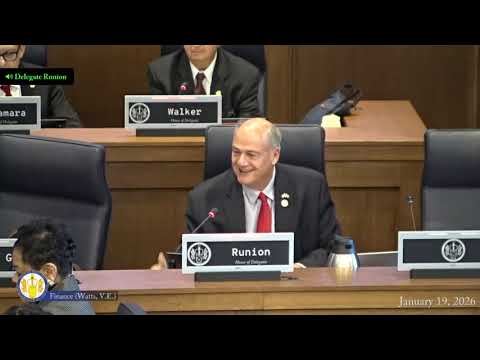
House Finance Committee hears state finance briefing on revenue structure and agency roles
Summary
State finance leaders briefed the House Finance Committee on the Commonwealth’s revenue mix, fiscal-impact processes and agency roles, and announced subcommittee assignments ahead of the 2026 session’s tax bill work.
Members of the Virginia House Finance Committee convened for orientation and briefings from state finance officials, who explained how accounting, treasury, budget and taxation functions support the Commonwealth’s fiscal operations and legislative review.
The presentations underscored why fiscal-impact statements matter to the committee’s work. Secretary Sickles introduced the four primary offices under the Secretariat—Treasury, Department of Accounts (Comptroller), Department of Planning and Budget (DPB) and Department of Taxation—and told members the agencies are available as resources. "We have the big 4 here today," the secretary said, asking members to rely on them for technical support.
Sharon Lawrence, the newly appointed State Comptroller, described the Department of Accounts’ responsibilities: maintaining the Commonwealth Accounting Policies and Procedures (CAP) manual, operating the Cardinal statewide ERP and centralized payroll, issuing consolidated financial reports relied on by bond raters, and enforcing internal control standards. Lawrence warned the committee that roughly half of senior leadership is eligible to retire within five years and said the department is actively recruiting new accountants.
Michael, director of the Department of Planning and Budget, told members that DPB produces the governor’s budget and the fiscal-impact statements used to evaluate legislation affecting the budget. He emphasized transparency of assumptions and noted DPB’s six-year planning tool and three-scenario forecasts (standard/plus/minus) that inform long-range balance estimates. He said DPB and the Department of Taxation collaborate on fiscal-impact work where appropriate.
Chair Watts and members repeatedly emphasized the committee’s gatekeeper role for spending and tax proposals and asked presenters to keep explanations practical and timely. The chair announced subcommittee assignments for state taxes, local taxation and other work, and closed the meeting after a motion to adjourn.
The committee is scheduled to consider tax bills in subcommittee and full committee over the coming weeks; presenters asked members to consult agency fiscal-impact work when drafting or amending legislation.
The meeting adjourned with assignments issued for Subcommittee 1 (state taxes), Subcommittee 2 (local taxation) and Subcommittee 3 (periodic Friday meetings).