Get Full Government Meeting Transcripts, Videos, & Alerts Forever!
Get email alerts on the Gas Transmission topic
No spam. Unsubscribe anytime.
Northwestern and pipeline operators outline major gas transmission investments needed to meet peak demand and economic development
Summary
Utility and interstate pipeline speakers told the committee Montana's gas transmission system met recent extreme peaks but needs large investments (hundreds of millions) to serve growing areas like Bozeman, and to enable industrial projects; options include Loomis interconnect expansion, CIG upgrades, and new storage with multi-year lead times.
Northwestern Energy and interstate pipeline operators briefed the committee on recent extreme winter peaks, how the company met the Jan. 2024 cold event, and what is needed to support future demand growth.
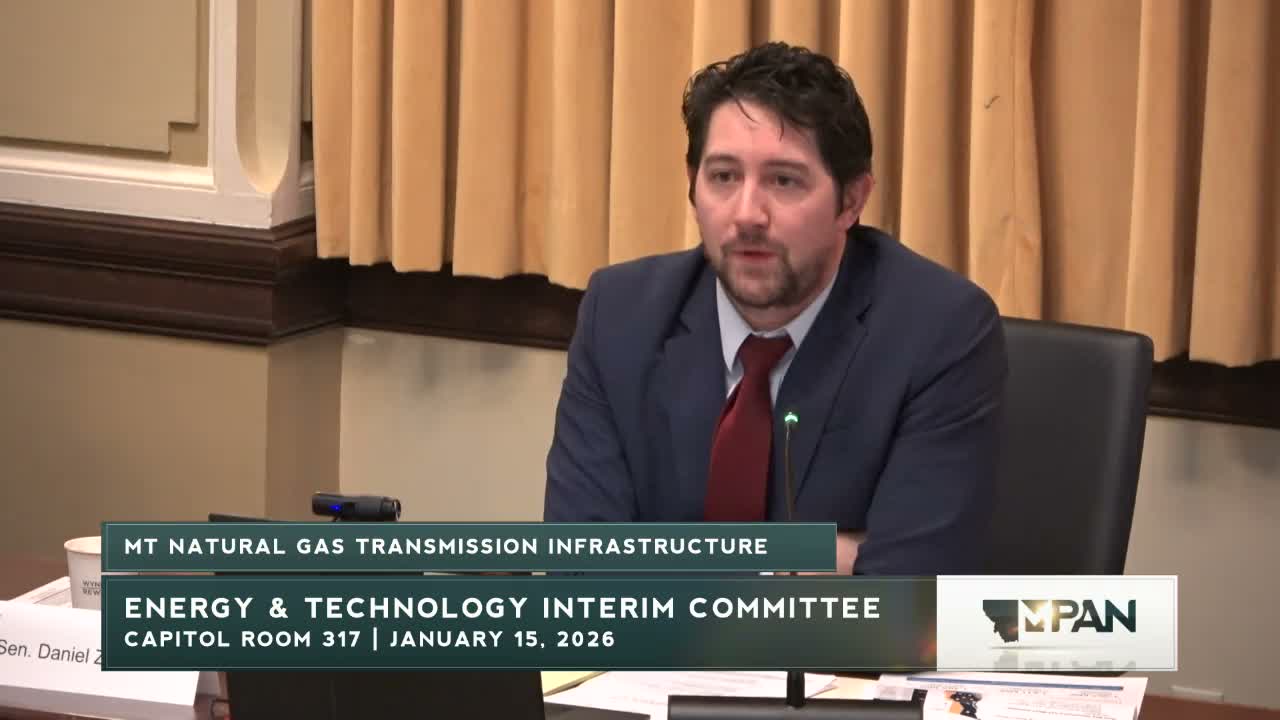
Mike Cashel, Northwestern27s vice president of transmission, described how a combination of interconnections, compression and storage served the system during the January 2024 extreme cold event. He explained that the company's Western and Eastern pipeline systems largely operate independently and that growth areas such as the Bozeman-Belgrade corridor now account for a large share of future demand and growth.
Cashel described options to increase supply: expanding the Loomis (Saskatchewan) interconnect (phase 1 estimated at about $230 million and 3235 years), constructing a new pipeline from Havre into south-central Montana (approximate 150,000 MMCF/day capacity) or expanding the CIG interconnect (more expensive, ~ $400M), or adding storage on system (also ~ $400M). He emphasized that these projects require a customer base and clear cost-allocation to be viable.
Mark Anderson of WBI Energy outlined how interstate pipelines provide firm transportation and storage services; current firm storage and transport capacity into key Montana markets (for example, Billings) is fully subscribed. WBI and other interstate operators described challenges to adding meaningful incremental supply because of long distances to gas-producing basins, rising pipeline construction costs and higher property taxes relative to some neighboring states.
Public comments from economic development leaders and trade groups highlighted missed opportunities when a large prospective industrial load could not be served because capacity was not available. Committee members and presenters agreed that large industrial projects need advance planning, longer-term commitments and clear mechanisms for cost recovery to justify multi-hundred-million-dollar infrastructure expansions.
What happens next: utilities and pipeline operators will continue to study interconnect and storage options and coordinate with state economic-development leaders. Committee members asked staff to track project-level studies and potential funding or tax policy changes that influence the economics of long-distance pipeline and storage expansion.