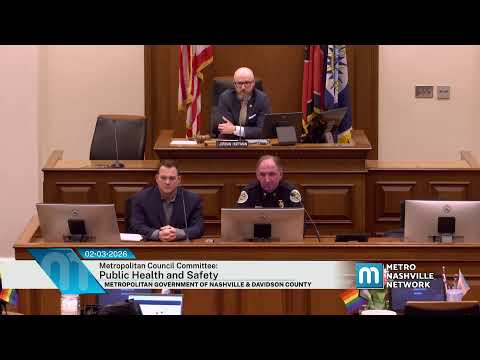
Council committee hears Partners in Care data, program asks funding to expand weekend coverage
Loading...
Summary
Mental Health Cooperative and Metro Police presented Partners in Care results to the Public Health & Safety Committee, reporting 3,884 mental-health responses in 2025, high diversion rates from emergency rooms and requests for funding to add weekend coverage and a permanent training coordinator.
Michael Randolph, director of co-response services at the Mental Health Cooperative, told the Metropolitan Council Public Health & Safety Committee that Partners in Care — a program embedding master's-level clinicians with patrol officers — handled 3,884 mental-health calls in 2025 and served about 3,000 unique individuals.
"Seventy-seven percent of the people we've seen in Partners in Care in 2025 had not been seen by the mental health crisis system before in Davidson County," Randolph said, summarizing the program's reach. He said roughly 50 percent of crisis calls can be resolved at the scene, about 70 percent are diverted from emergency rooms, and roughly 10 percent result in direct transport to psychiatric treatment or the crisis treatment facility.
Captain Anthony Brooks of the Metro Nashville Police Department’s Office of Alternative Policing Strategies described the program's data-driven rollout, noting clinicians are embedded at precincts and officers receive crisis intervention team (CIT) training. "We did a lot of research on the front end to see where the highest volume of potential mental health crisis calls were occurring," Brooks said, explaining the initial pilot and subsequent citywide expansion.
Presenters said staffing remains constrained: Partners in Care operates Monday through Friday from 6 a.m. to midnight and does not currently provide weekend or full overnight coverage. Brooks and Randolph asked the committee to consider budget requests to expand weekend hours and to fund a permanent training coordinator position that had been previously supported by American Rescue Plan Act dollars.
Council members pressed for operational details. When asked how officers request clinician support on scene, Brooks said officers use radio designations to summon the clinician car ("Car 95") if available. Council member Allen asked whether the program produces quantifiable cost savings by reducing bookings; Brooks said the department tracks probable-cause arrests and could provide an estimate and follow up with the committee.
Randolph described the involuntary committal pathway and bed limitations: clinicians can initiate a 64-04 certificate if a person is an imminent danger, use diversion beds at Metro Center's crisis-treatment facilities, and refer to the Middle Tennessee Mental Health Institute (which he estimated to have roughly 187 beds and a waitlist that can take two to three days for evaluation and admission). "We will start the patient bed matching system, make the referral to MTMHI, and begin that process," he said.
Both presenters highlighted safety metrics and outcomes: Randolph said the program served many people who later reported improved housing or employment, and he noted that in the program’s four years there have been no crisis counselors injured on mental-health calls. Brooks said the arrest rate in 2024 for PIC responses was about 4 percent and that overall program arrest rates since 2021 average about 4.5 percent, with use-of-force rates described at roughly 2.4–2.5 percent across crisis interactions.
The committee asked staff to return with additional data requested during the meeting — specifically, an estimate of booking or detention cost savings associated with the program and disaster-period segmentation of data to examine acuity during events such as the recent winter storm. The committee also was reminded of a joint hearing next Tuesday with Transportation & Infrastructure to review emergency communications.