Get Full Government Meeting Transcripts, Videos, & Alerts Forever!
Get email alerts on the Infrastructure Policy topic
No spam. Unsubscribe anytime.
Commission amends new policy for infrastructure development districts after hours of debate; D.R. Horton MOU deferred
Summary
After extended debate, the commission adopted a substitute motion adding community-meeting requirements, quarterly reporting and rural-area questions to a draft policy for infrastructure development (special-assessment) districts. A memorandum of understanding with D.R. Horton was deferred 30 days for staff work.
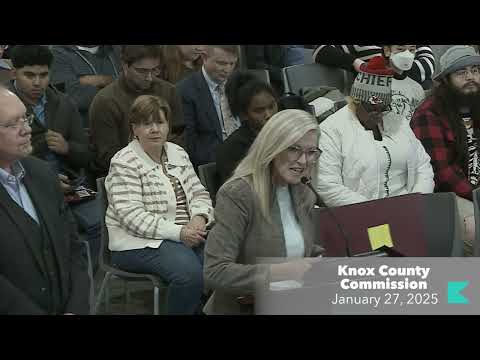
The Knox County Commission spent much of its Jan. 27 meeting debating a proposed policy to guide petitions for infrastructure development districts (special assessment or "RID" districts), and approved a substitute motion that strengthens community input and reporting requirements.
Commissioner Frasier offered five amendments to the draft policy that would: require (rather than merely expect) a community meeting for petitioners; add quarterly reporting by the county engineering department with developer cooperation; require environmental study contingencies be addressed; and add questions to the application form to force petitioners to justify projects in rural areas against the county's growth plan. After extended discussion of legal limits and policy tradeoffs, commissioners passed the substitute motion by voice vote.
"If you wanted to change 'will be expected' to 'required,' I don't see anything in the statute that would prevent that," County law director Mike Moyers said, addressing whether the commission could condition petitions on community meetings.
Legal counsel Mark Mamontoff explained limits imposed by case law and constitutional takings doctrine when commissioners asked whether the county could compel developers to perform off-site improvements beyond traffic-study requirements. "Nolan Dolan" was invoked in colloquial discussion as the legal context — counsel said takings-law constraints mean the county cannot force developers to give property or perform work without compensation beyond what is required by statute and court precedents.
Commissioner Jay framed the policy as a tool to avoid the county's long history of under-investing in infrastructure: "Developers will always do the minimum, exactly what we require of them," he said. Supporters urged a workable policy now and continuous improvement; critics warned of long-term management burdens and urged narrowing district-authorized expenditures to only county-beneficial "above-and-beyond" improvements.
Separately on Item 43, commissioners agreed to defer for 30 days a memorandum of understanding with D.R. Horton for road improvements at Tipton Station Road and Martin Mill Pike while staff and engineering complete outstanding work.
Next steps: The policy will be implemented as amended and used to evaluate future petitions; commissioners said they will monitor how the tool is used and plan a one-year reassessment clause in the policy language.