Get Full Government Meeting Transcripts, Videos, & Alerts Forever!
Get email alerts on the Eviction Prevention topic
No spam. Unsubscribe anytime.
Legal Aid tells Knox County commission its eviction-prevention program cut judgments and saves county money
Summary
Legal Aid of East Tennessee briefed commissioners on its county-funded Eviction Prevention Program (EPP), saying the 14-month pilot prevented judgments in 308 cases and helped about 650 people; program funding supplied by ARPA ends May 2025 and staff urged county support to maintain services.
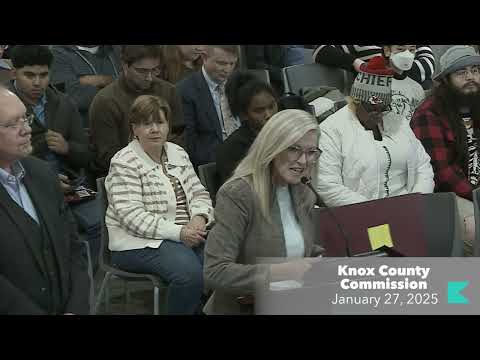
Deborah House, executive director of Legal Aid of East Tennessee, told the Knox County Commission on Jan. 27 that the county-funded Eviction Prevention Program (EPP) has significantly reduced eviction judgments and produced community savings.
"We've seen 577 cases come through our door," House said. "486 were evictions, 338 resolved by our staff, and 308 cases had a judgment prevented — a 91 percent success rate." She said the program has assisted approximately 650 people, including about 275 children, over a 14-month period.
House said EPP operates out of a neighborhood office staffed with five attorneys and three paralegals paid with ARPA funds provided by Knox County; that funding is set to end in May 2025. She highlighted a cost-benefit estimate in the program's materials: "For every dollar invested in our EPP project there is a return of $6.14," she said, citing handouts provided to commissioners.
Michael Davis, a managing attorney with the program, described the office as an "emergency room" for tenants who receive notice to appear in eviction court. "We can't legally prevent landlords in Tennessee from increasing rent," Davis said, "but when people get served with a detainer warrant they need somewhere to turn and we provide answers and negotiate agreements."
Commissioners pressed staff on program sustainability and where cases are concentrated. House said before the ARPA funding the county supported a much smaller effort—one attorney covering eviction court—and that program leaders are actively seeking a funding mix from the city, county, United Way and other partners to sustain the EPP.
Davis pointed to data and mapping work by the University of Tennessee and said eviction filers come from neighborhoods across Knox County, with notable concentrations in Old North Knoxville, East Knoxville, northwest pockets near downtown and some areas of South Knoxville.
Several commissioners, including Commissioner Jay and Commissioner Thompson, said they appreciated the program's work and asked staff to engage in the county's upcoming budget conversations. House and Davis said they would be available to provide additional details to commissioners as budget deliberations approach.
Next steps: Program staff said they are meeting with potential funders to seek sustainability beyond the May 2025 ARPA cutoff and that commissioners will be contacted during the county's budget process.