Get Full Government Meeting Transcripts, Videos, & Alerts Forever!
Get email alerts on the Vision 2040 topic
No spam. Unsubscribe anytime.
Newport workshop reviews Vision 2040, identifies infrastructure funding and staffing as near‑term priorities
Summary
City staff refreshed council and participants on the Greater Newport Area Vision 2040, presented county-level ALICE and Census data, and led a context‑mapping exercise that produced consensus priorities: funding for infrastructure and maintenance, technology integration, and employee recruitment and retention.
At a City of Newport workshop (date not specified), councilors, staff and community participants reviewed the Greater Newport Area Vision 2040 and worked through a context‑mapping exercise to identify priorities for the coming fiscal year. Staff summarized county‑level demographic and economic data and asked tables to propose three realistic priorities for next‑year work plans.
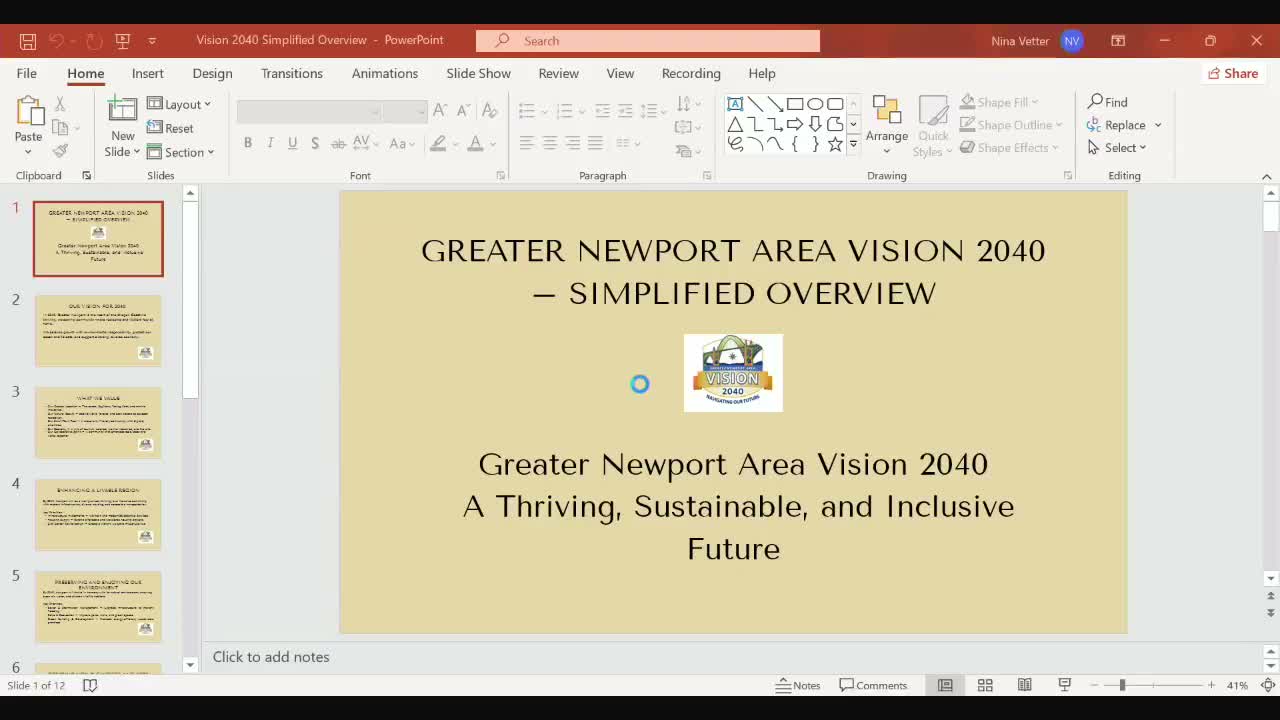
The workshop featured a presentation of Vision 2040’s core values and six strategic areas — enhancing livability, preserving the environment, economic growth, education and creativity, community health and safety, and collaboration and civic engagement — accompanied by a set of 73 strategies in the full plan. Presenter Laura Gia said the Vision is meant to guide decision‑making and recommended pairing the long‑range plan with rolling five‑year implementation steps to keep the strategy actionable.
Staff presented a local context snapshot drawn from Census sources and the Ford Family Foundation’s ALICE metric. According to staff, Lincoln County (county‑level data, not city‑only) has a median age about 25 percent higher than the Oregon average, median household income roughly two‑thirds of the state median, a poverty rate cited at 17.2 percent (state average 11.9 percent), and an estimated 47 percent of households below the ALICE threshold. Gia described ALICE as an indicator of households that are above the poverty line but still struggling to meet basic needs.
Following the data review, participants completed sticky‑note context mapping in small groups. Tables repeatedly flagged: (1) limited funding for capital and preventative maintenance; (2) workforce challenges, including recruiting and retaining city employees; (3) aging infrastructure and water/stormwater system needs (including the long‑term Big Creek Dam project); (4) rapid construction‑cost escalation that pressures project budgets and timelines; and (5) the effects of tourism on housing availability and infrastructure demand.
Group reports converged on a short list of implementable priorities for the next fiscal year: pursuing diversified revenue sources (franchise agreements, tourism‑related fees, sponsorships, targeted grants), integrating and coordinating city technology to improve internal communications and public access to information, and developing employee incentives and programs to improve recruitment and retention (examples discussed included employee housing strategies and childcare partnerships).
Throughout the session staff emphasized the difference between the aspirational 20‑year Vision and near‑term, fundable actions. Gia framed the day’s work by reading a quotation about the trade‑offs of local leadership: “Leadership and local government is a paradox… Every decision you make isn’t just a choice, it’s a commitment… We trade the long term welfare of our communities for the short term illusion of success,” and urged the council to pair Vision‑level goals with SMART, time‑bound next steps.
No formal votes or motions were taken at the workshop; instead staff said they would consolidate the exercise results and prepare a draft council goals document for review as part of the upcoming budget work. Staff thanked the planning team (named in the session as Jason, John, Laura and Zia) and the mayor adjourned the meeting.
What happens next: staff will translate the day’s prioritized items into a draft work program and proposed budget implications for council review in the coming budget cycle. The workshop materials noted several multi‑year projects (Big Creek Dam, sewer upgrades, street reconstruction) that will continue to require external funding and staged implementation.
Quotes from the meeting
“By 2040, Greater Newport is the heart of the Oregon Coast, a thriving, welcoming community…” — Laura Gia, presenter.
“The ALICE threshold represents households that are above the poverty level but are still struggling to make ends meet.” — Laura Gia, presenter.
“We heard a lot about funding… a lot about needing to find new funding solutions, including tourist‑related fees, franchise agreements and sponsorships.” — Presenter summary.
Ending
Staff will prepare a draft council goals document that reflects the day’s outputs and recommended near‑term priorities; that draft will be circulated to council for formal consideration and then used to inform departmental goals and the city’s capital improvement program.