Subcommittee advances 'Buy American Iron and Steel' bill after industry testimony
Loading...
Summary
The Business and Commerce Subcommittee on Jan. 20 heard industry testimony on House Bill 4709, the Buy American Iron and Steel Act, and voted to give the bill a favorable report after proponents—including Nucor, the Iron Group and American Spiral Pipe Company—argued it would protect domestic manufacturers and jobs. No final action was taken beyond the recommendation.
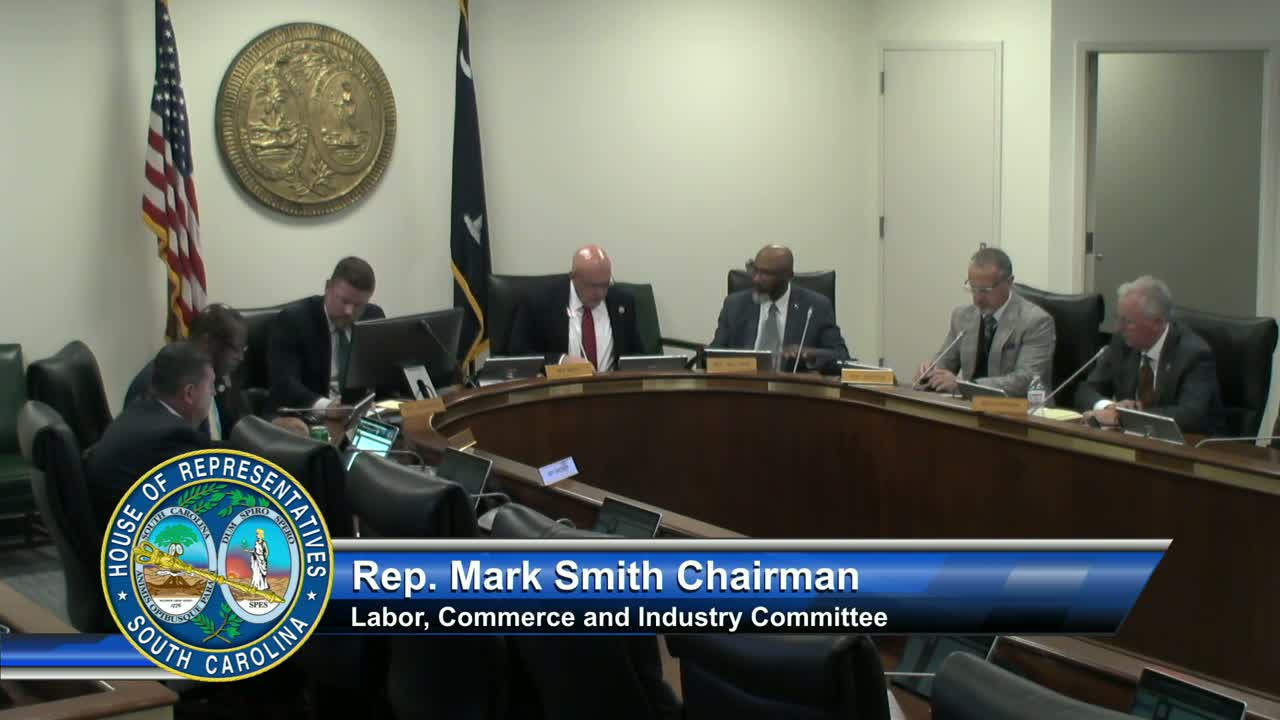
COLUMBIA, S.C. — The House Business and Commerce Subcommittee voted Jan. 20 to give House Bill 4709, the Buy American Iron and Steel Act, a favorable report after hearing testimony from steel producers and fabricators who said the measure would preserve jobs and ensure greater traceability of materials used on state-funded infrastructure.
Representative Ritchie Yau, the bill sponsor, told the committee the proposal ‘‘simply clarifies and solidifies’’ that state-funded public works projects that permanently incorporate iron or steel should use materials produced in the United States. ‘‘It is simply buy American iron and steel,’’ Yau said, urging support for local workers in places such as Darlington County.
The bill’s supporters framed the measure as aligning state procurement rules with existing federal Buy American and American iron-and-steel requirements. Bill Paxton of the Iron Group said the proposal ‘‘levels the playing field’’ for domestic foundries and helps preserve rural jobs, arguing that unfair foreign competition from countries such as China, Turkey and India has damaged U.S. capacity. ‘‘If the state is using taxpayer funds to pay for infrastructure projects, then we ought to be using American-made iron and steel,’’ Paxton said.
Devin Webster, vice president and general manager of Nucor Buildings Group, described Nucor’s South Carolina footprint and said U.S. mills using electric-arc furnaces are more environmentally sustainable than traditional blast-furnace operations. Webster said Nucor supports the bill as a way to ‘‘level the playing field’’ and noted the company’s stated goal of reaching net-zero emissions across scope 1, 2 and 3 by 2030.
Pat Hook, president of American Spiral Pipe Company, told the panel his Columbia-based firm and its parent company supply large-diameter spiral-welded steel pipe used in water transmission projects and argued the bill would strengthen a local supply chain that includes fabricators, trucking firms and other downstream businesses. Hook cited recent investments in his facilities, including a new pipe-coating line he said cost $15,500,000 and a broader $50,000,000 expansion.
Committee members questioned witnesses about product quality, traceability and cost. Representative Williams pressed sponsors on whether U.S. steel is demonstrably different from imports and asked about the cost trade-offs for municipalities and water-line repairs; witnesses relied largely on industry experience and supplier certifications to describe traceability and safeguards. Paxton and others said the bill includes waiver mechanisms taken from federal law—an unavailability waiver, a cost-based waiver if domestic materials increase project cost by more than 25 percent, and a public-interest waiver—to avoid delaying projects.
After roughly three hours of testimony and questions, Representative Anderson moved for a favorable report and members approved the motion by voice vote. The committee did not take final action to enact the bill; it will return for at least one more subcommittee hearing before possible consideration by the full committee.
The committee’s action sends a recommendation supporting the bill forward in the process; any future votes, roll calls or final disposition will be recorded in subsequent committee or floor minutes.