Get Full Government Meeting Transcripts, Videos, & Alerts Forever!
Get email alerts on the Parks Recreation topic
No spam. Unsubscribe anytime.
Parks and recreation budgets frontload large share of township operating costs; aquatics recovers half of operating expenses
Summary
Parks and Recreation staff told the board maintenance of 151 parks, 70 lakes and an extensive streetscape network accounts for sizable operating costs; staff said aquatics covers about 50% of operating costs through fees while recreation programs are 100% cost‑recovery.
Parks and Recreation officials told the board on June 25 that the township’s parks system — spread over 44 square miles — drives significant operating expense, including contracted maintenance, lake management, street lighting and large event programming.
Chris Nunez, who led the parks briefing, said the parks operation maintains 151 parks, roughly 70 lakes and ponds, and more than 220 miles of maintained right‑of‑way. Base contracted maintenance for the parks system is roughly $2,800,000, he said, provided by three contractors at different service levels. Lake management visits are scheduled about 48 times per year for inspections and treatments; restroom cleaning is managed under contract for 30 restrooms across the system.
Nunez highlighted Town Center responsibilities — a 1.8‑mile Waterway linear park, lighting and special events — and previewed holiday programming (Waterway Wonderland) and the ice rink. He also noted a $1,000,000 forest management line to address tree removal and planting after freezes and drought conditions.
On aquatics and recreation, staff said 14 pools and six spraygrounds operate with about 50% of operating costs offset by user revenue; recreation programming is largely a 100% operating cost‑recovery model, with capital needs still funded by the township. Staff emphasized program revenue (tennis, day camps, boathouse and special events) and the role of marketing and cost controls in meeting cost‑recovery goals.
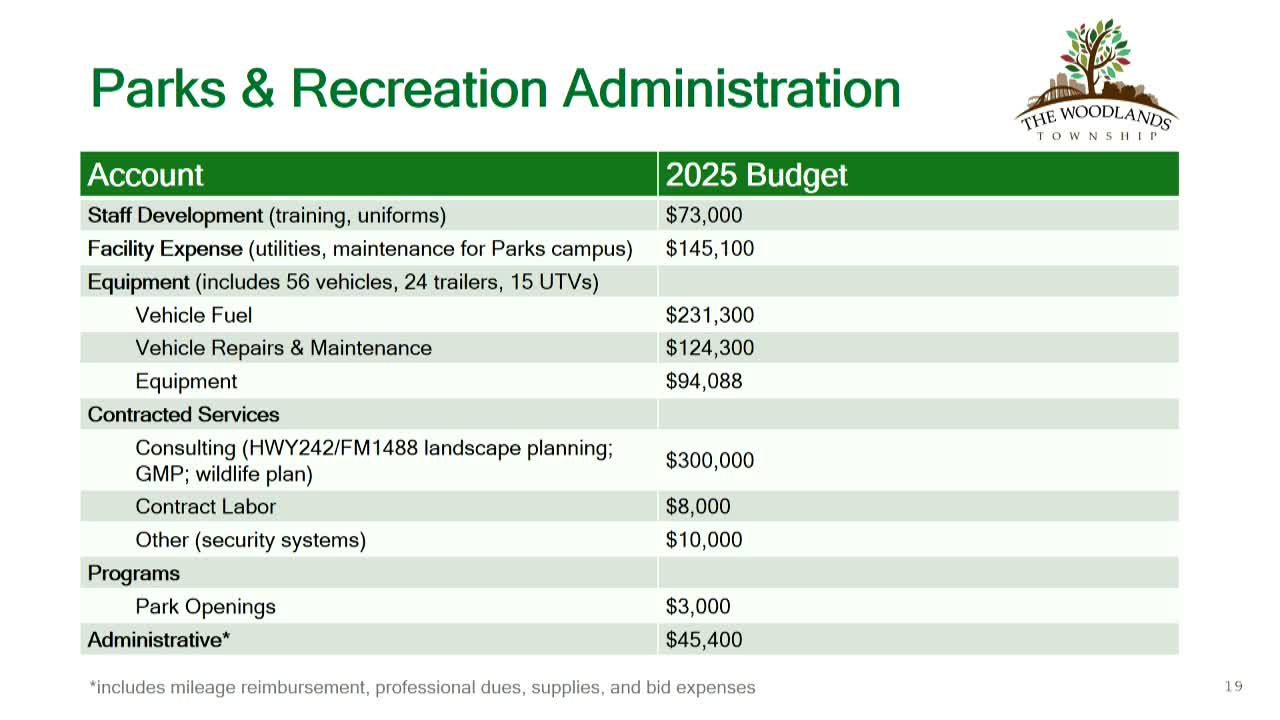
Directors asked whether vehicle sharing or a pool vehicle might reduce mileage reimbursement; staff noted fleet size (56 vehicles for parks) and parking constraints, and said they could run further analysis.