Get Full Government Meeting Transcripts, Videos, & Alerts Forever!
Get email alerts on the Law Enforcement topic
No spam. Unsubscribe anytime.
Township flags $625,000 body‑camera payment and $550,000 annual operating cost for law enforcement
Summary
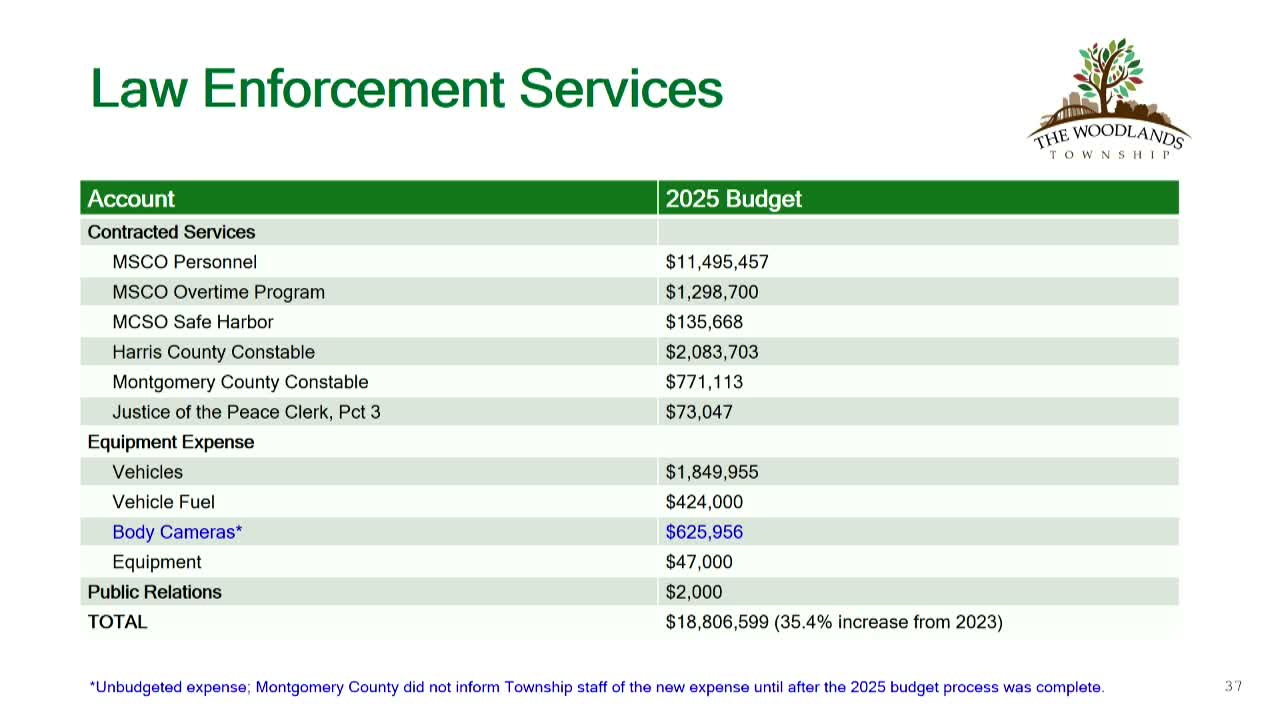
Staff told the board an unbudgeted $625,000 body‑camera payment appears on the consent agenda for 2025 and annual operating costs run about $550,000; directors questioned capital vs. operating treatment and whether county partners should bear some costs.
Township staff told directors on June 25 that the law‑enforcement budget includes an unbudgeted $625,000 body‑camera payment in 2025, with an estimated annual operating cost of about $550,000 thereafter.
Karen Dempsey, who led the presentation on customer engagement and law enforcement contract items, said staff negotiated the purchase schedule so that some of the camera cost is spread across two years. "The total cost of the body cameras is more than that, but the way that our contract, we were able to negotiate to get that spread across two years so that we didn't take the total hit in one year," Dempsey said. She added that the township will incur ongoing operating costs to manage and support the system.
Directors asked why the cameras were not treated as capital; Dempsey explained the township does not own the vehicles and that equipment installation and ongoing operating obligations create an annual operating expense. Board members pressed whether the county should pick up some costs and questioned whether other long‑standing items the township funds — such as the justice‑of‑the‑peace clerk position — might be candidates for reallocation to offset new obligations. One director said, "With a surprise $625,000...and a $500,000 recurring cost, the county can pay for the clerk," prompting staff to note the clerk position has been funded historically by the township and that any change would be a board decision.
The body‑camera payment is listed on the consent agenda for later action; the board did not adopt a final funding decision during the workshop and directed staff to include the item in the upcoming budget process for further consideration.