Get Full Government Meeting Transcripts, Videos, & Alerts Forever!
Woodlands board reviews 2026 budget framework, weighs tax-rate choices and rising public-safety costs
Summary
At a budget workshop, The Woodlands Township staff outlined a $175 million 2026 base budget, projected revenues, and options for the tax rate; moving to the 'no new revenue' rate would cut revenue roughly $3.3 million and shrink the projected undesignated balance, while pay-parity pressure for contracted law enforcement and rising personnel costs were flagged as major budget risks.
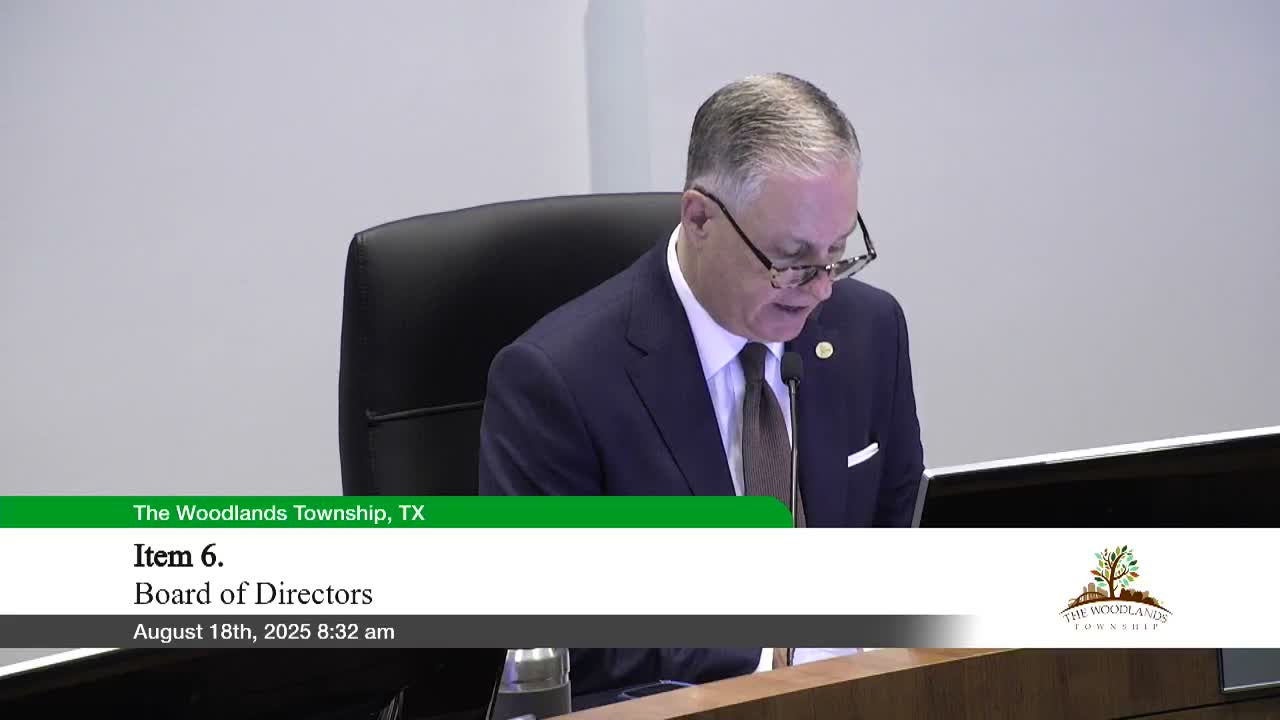
Monique Sharp, president and CEO of The Woodlands Township, opened Budget Workshop No. 1 with an overview of the proposed 2026 consolidated budget and the calendar for setting a proposed tax rate ahead of a Sept. 5 adoption vote. Sharp said the township’s current tax rate is 17.14¢ per $100 of valuation, the no-new-revenue rate is 16.03¢, and the voter-approval rate is 18.89¢; she emphasized that a board vote this week would set a proposed rate for public-notice purposes, not the adopted rate.
Sharp presented 2026 base-budget projections of roughly $175 million in operating revenues, with sales and use tax estimated at about $81 million (47% of revenues) and property tax comprising roughly 30%. She outlined scenarios showing that adopting the no-new-revenue rate would reduce township revenues by about $3.3 million; for a $500,000 home, that scenario was modeled as a roughly $53 annual saving for the owner. Sharp also noted the township’s projected undesignated fund balance would be about $655,000 under the base budget, and that using the no-new-revenue rate would create a larger shortfall that would require further budget reductions or other offsets.
Sharp flagged revenue risks and concentrations: one manufacturing taxpayer accounts for an outsized share of manufacturing-related sales-tax growth, and interest income — previously an occasional source of…
Already have an account? Log in
Subscribe to keep reading
Unlock the rest of this article — and every article on Citizen Portal.
- Unlimited articles
- AI-powered breakdowns of topics, speakers, decisions, and budgets
- Instant alerts when your location has a new meeting
- Follow topics and more locations
- 1,000 AI Insights / month, plus AI Chat