Riviera Beach board approves $280.4 million GMP for new water treatment plant after cost review
Loading...
Summary
The Utility Special District approved Resolution 03‑26UD to move forward with GMP 5 — the water treatment plant — after independent cost comparisons showed Riviera Beach’s price is competitive with Delray Beach and lower than Fort Lauderdale on an adjusted basis; the board discussed funding options including SRF, WIFIA and resident mini‑bonds.
Riviera Beach’s Utility Special District voted to approve Resolution 03‑26UD on Feb. 5, 2026, authorizing the city manager to issue a purchase order for GMP 5 to build a new ultrafiltration/nanofiltration/reverse osmosis water treatment plant. The clerk read the resolution into the record, and the board approved the motion by roll call.
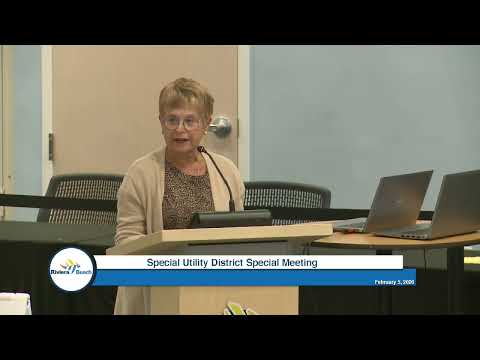
Consultants and the city’s owner’s representative presented independent cost comparisons that adjusted the Riviera Beach GMP to align features and capacity with two nearby projects. Sue Melamed, a licensed engineer and Riviera Beach resident, walked the board through adders and deducts — including capacity differences, pretreatment, laydown/lease costs, clear‑well and odor control — and reported that, after those adjustments, Riviera Beach’s plant compared closely with Delray Beach (adjusted Delray cost about $201.7 million; Riviera Beach adjusted to about $203.1 million). Nigel Grace of Brown & Caldwell, the city’s owner’s representative, presented a parallel analysis and said Riviera Beach’s adjusted cost per gallon was lower than Fort Lauderdale’s on the same basis (about $14.3 per gallon for Riviera Beach vs. about $16.1 for Fort Lauderdale).
“We captured the major cost adders and the major cost deducts,” Melamed said, and Grace added the off‑ramp (reprocurement) would take an estimated 12 to 15 months and could add cost. Grace summarized the market drivers, including a tight urban site, limited bidder competition for some specialty trades and a longer four‑year construction duration for Riviera Beach.
City staff and the city manager framed the approval as a financing decision to follow. City Manager Jonathan Evans said staff had submitted SRF (State Revolving Fund) applications and had been accepted into WIFIA; SRF feedback was expected Feb. 11. Evans described a capital‑stack approach that could include SRF, WIFIA, grants, traditional bonds and a proposed mini/micro bond program that would let local residents buy small‑denomination bonds to participate directly in financing the plant.
“We will continue to actively seek any type of earmarked funding or grant funding,” Evans said, adding that staff would present comprehensive financing options before the city goes to the bond market. Director Joshua Niemann told the board that GMP 5 covers the plant itself and that the total program cost across GMP phases (including prior GMPs and upcoming GMP 6/7) is currently estimated in the roughly $400–$420 million range.
Public comment on Item 8 was overwhelmingly supportive: more than a dozen Riviera Beach residents thanked staff and urged the board to proceed without delay, citing both the public‑health benefits and the rising construction market. Mary Grama said the plant would reduce residents’ dependence on bottled water, and several speakers pressed staff for specific technical answers about lead pipes, hurricane resilience and expected construction impacts on local roads. Staff replied that the city completed a lead pipe inventory and will implement corrosion control measures during staged startup to avoid disturbing in‑place lead piping.
The vote: the clerk recorded affirmative votes for board members present and the resolution passed. Staff said a groundbreaking would be scheduled before the end of February and that construction would likely span into 2028–2029.
Why it matters: the new plant is intended to replace aging treatment capacity that staff said will not meet forthcoming PFAS regulations; staff reported nearly $10 million has been invested in refurbishing the existing plant but that the treatment process must change to meet future standards. The decision commits the district to the construction contract under the GMP 5 procurement and moves the project into the financing and execution phase.
Next steps: staff will return with detailed financing recommendations (SRF/WIFIA/bond options and proposed mini‑bond mechanics), finalize GMP 6/7 numbers (raw and finished water transmission lines and roadway upgrades), and prepare for the public groundbreaking.