Get Full Government Meeting Transcripts, Videos, & Alerts Forever!
Get email alerts on the Plastic Straw Ordinance topic
No spam. Unsubscribe anytime.
Heated public comment and legal questions follow proposal to review Saint Petersburg straw ban; council member withdraws item
Summary
Council member Corey Givens brought a new-business item to revisit the city's single-use plastic straw ordinance; dozens of speakers urged keeping the ban, legal staff clarified ADA exceptions and federal executive order scope, and Givens ultimately removed the item after public comment and council discussion.
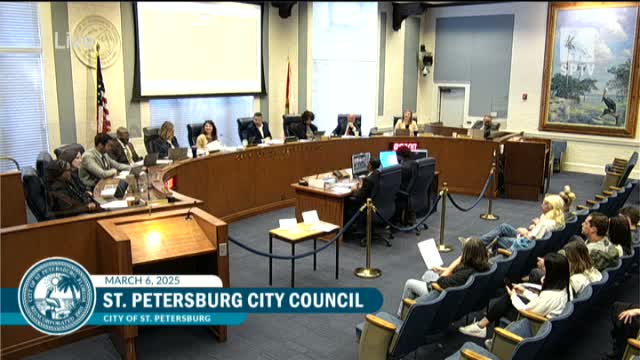
Council debate over the city's seven-year-old ordinance limiting single-use plastic straws drew a large public turnout and extended discussion before the item was withdrawn.
Council Member Corey Givens introduced a new-business request to consider "lifting" the regulation and referred it to committee. That proposal prompted many members of the public and a broad cross-section of local environmental and business advocates to speak in favor of keeping the ordinance.
Speakers emphasized local control and environmental concerns. Thomas Patrick, representing local organizers behind the original campaign, told council: "Removing this ban doesn't solve anything. It just strips away one of the last remaining tools St. Pete has to combat plastic pollution." Several speakers cited local monitoring efforts and cleaner waterways after the ban's adoption.
Members of the business community and council asked about enforcement and legal exposure. Legal staff clarified the ordinance includes an exception for customers who have a "physical or medical need requiring the use of a single use plastic drinking straw." Michael Deema, speaking for the city attorney's office, said the ordinance was drafted with that ADA accommodation explicitly included. "The exception relates to customers with a physical or medical need requiring the use of a single use plastic drinking straw," Deema said.
Council members also discussed a recent presidential executive order mentioned in the debate; staff said the executive order addressed federal procurement and the "forced use of paper straws" and did not directly affect the city's local ordinance. Legal counsel and administration staff said they are monitoring state and federal activity and will flag any changes that could create conflict with local code.
Several council members said the item as worded ("lifting" the regulation) did not match the narrower enforcement discussion they would support. Council Member Givens said he had brought the item because he was concerned about potential litigation and wanted to explore alternatives; after hearing public comment and council feedback, he withdrew the new-business item.
Because the item was removed from consideration, no vote to repeal or amend the ordinance occurred. Council members and staff suggested focusing on education and better enforcement in partnership with local environmental groups, event organizers and businesses going forward.
Next steps identified by council included outreach to disability advocates and local business groups about enforcement and accommodations, and continued monitoring by the city attorney's office for any state or federal changes that might affect local authority.