Get Full Government Meeting Transcripts, Videos, & Alerts Forever!
Get email alerts on the Zoning topic
No spam. Unsubscribe anytime.
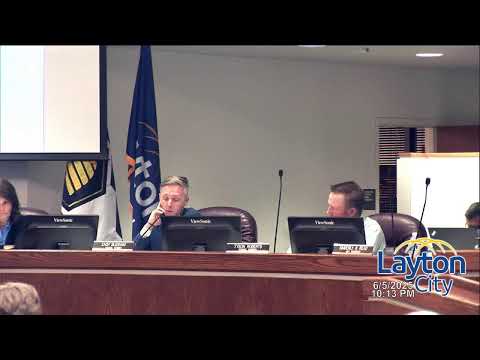
After lengthy public comment, Layton council approves Hobbs Creek Village PRUD with conditions
Summary
Council adopted the Hobbs Creek Village R-1-10 PRUD (ordinance 25-08) after staff and developer added lot‑pad adjustments and presented geotechnical findings; the final vote was 4–1 following extensive public testimony on slope stability, trail alignment and parking.
Layton City Council voted on June 5 to adopt ordinance 25-08 and resolution 25-16, approving the Hobbs Creek Village planned residential unit development (PRUD) after several meetings and an extended public hearing.
City planning staff and the developer presented adjustments to several building pads (lots 102, 106, 108, 110 and 118) to add at least a five-foot separation from mapped 30% slopes. Staff cited third-party geotechnical reviews and slope-stability analyses showing that the revised pad locations and proposed construction methods meet engineering standards; staff also described proposed landscape screening and design features to reduce surface-water infiltration and protect the hillside.
Residents raised consistent concerns: whether historical core sampling and geotechnical coverage are sufficient; potential property-value and insurance impacts for adjacent homeowners; trail alignment near the Anderson property (which neighbors say could encourage trail users to park in the neighborhood); and potential liability under property-rights law if a private property is effectively surrounded by public access. Developers and staff responded that the project was redesigned to reduce slope exposure, that drainage and vegetation will be managed to limit infiltration, and that the trail alignment was chosen for emergency access and to avoid steep switchbacks.
Council members described careful review of reports and site visits; one councilmember voted no, citing unresolved concerns. The council majority concluded the PRUD, with its clustering approach and development agreement requirements, best addresses sensitive-lands constraints while allowing the property owners to sell.