Get Full Government Meeting Transcripts, Videos, & Alerts Forever!
Get email alerts on the Wastewater Policy And Infrastructure topic
No spam. Unsubscribe anytime.
Thompson's Station utility board advances wastewater projects and staff-led reservation policy changes
Summary
The Utility Board recommended that the town add a drip-field policy map to the All Aboard comprehensive plan and voted to forward an ordinance to BOMA that would change wastewater reservation rules: active capacity would require full payment up front and inactive capacity a 10% nonrefundable deposit; staff would handle routine approvals. Staff also updated members on bids and the plant startup timeline.
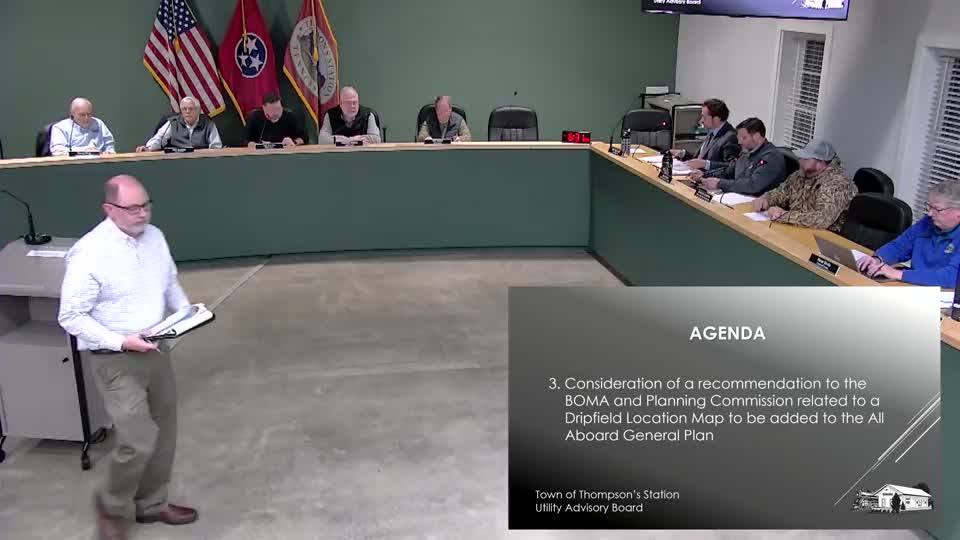
Thompson's Station's Utility Board voted Jan. 20 to forward two staff recommendations to the Board of Mayor and Aldermen: include a drip-field location policy map in the town's All Aboard comprehensive plan and advance an ordinance revising the wastewater reservation process.
The board's vote followed a staff presentation that described how the drip-field policy map had been created by screening for suitable soils, proximity to existing wastewater infrastructure and undeveloped parcels. "This is only a policy plan map," a staff presenter said, stressing the map "doesn't specify that we're buying these properties tomorrow" but would help target future expansion and capital planning for drip fields.
On the reservation ordinance, staff outlined several substantive changes they described as a holistic update to the 2020 process. Under the proposed changes, active capacity would require the full wastewater impact fee up front, while inactive capacity would require a 10% nonrefundable deposit (staff said the current ordinance requires a 25% deposit that cannot be used until the applicant reaches later milestones). Staff also said routine approvals for reservations would move from BOMA to an administrative staff-level process, with any deviations returned to BOMA.
"Active capacity requires the full payment of the wastewater impact fee upfront, and if it's inactive capacity, it would now require a 10% nonrefundable deposit," staff said during the meeting, adding the change would allow the town to use collected funds immediately for system improvements.
Board members raised questions about appeals (staff said they had not finalized an appeal path but viewed capacity allocation as an administrative 'yes-or-no' determination) and how the revised rules would affect developers who prepay fees. Staff noted several developers have volunteered to prepay impact fees and that some upgrades and parts will be ordered when a prepaid developer moves forward. The board moved and seconded both recommendations; the chair called the votes and members answered 'Aye.'
Beyond the policy items, staff provided project updates: the Highway 31 gravity sewer project was out to bid (staff reported a low bid around $4.2 million and 8–10 bidders), phase‑1 easements have been acquired, and a preconstruction meeting is expected in mid to late February. Staff also reported that the new plant's membrane bioreactor (MBR) vendor, Veolia, is completing prestart integration and that the plant's projected startup remains around March, though the schedule could shift.
The utility board asked staff to provide monthly capacity-tracking attachments going forward and requested a forecast of near-term commercial capacity requests to inform any allocation-percent proposals. Staff said they will reconcile reservation lists and return with additional data next month. The board adjourned at the end of the meeting.