Get Full Government Meeting Transcripts, Videos, & Alerts Forever!
Get email alerts on the State Budget topic
No spam. Unsubscribe anytime.
House Appropriations chair outlines 2025-26 budget framework and revenue proposals
Summary
Majority Appropriations Chair Jordan Harris and committee staff presented a $133.7 billion budget framework for fiscal 2025-26, outlining proposed revenue measures — a minimum-wage increase, adult-use cannabis legalization and skill-game taxation — and priority investments in health, education, transit and workforce programs.
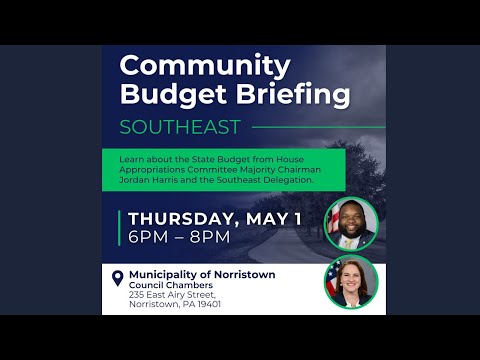
Representative Jordan Harris, chair of the Pennsylvania House Appropriations Committee, and the committee’s executive director Courtney Richardson laid out the broad contours of the Commonwealth’s fiscal 2025-26 plan at a Southeast Delegation briefing in Norristown on April 28, 2025. Richardson said the total budget under consideration is $133,726,000,000, with a general fund of about $51.5 billion and federal funds accounting for roughly 40 percent of the total.
The committee framed the budget as a package of bills rather than a single document, with the General Appropriations Act (GAA) carrying line-item spending, the fiscal code explaining how line items operate, the school code setting education formulas, and the tax code covering any changes to taxes. “The GAA is the General Appropriations Act. That is where we take the numbers and all of the line items and we put them into a legislative format,” Harris said.
Courtney Richardson provided the administration’s revenue and transfer proposals. She said the budget-stabilization (rainy day) fund stood at about $7.35 billion as of April 28, 2025, and the current proposal would move $1.6 billion from that reserve into the general fund for next year while also projecting a $321.5 million transfer into the fund for the current fiscal year. "We will have an on time budget," Richardson added, describing the timetable that aims for a June 30 completion.
Richardson outlined three principal revenue drivers in the governor’s proposal. First, a phased raise in the minimum wage to $15.00 per hour (with tipped workers at $9.00) effective Jan. 1, 2026, which the committee estimated would increase state revenues by about $51.5 million in FY 2025-26. Second, legalization of adult-use cannabis with a proposed 20 percent wholesale tax and licensing fees, which Richardson said is forecast to generate roughly $536.5 million in the first budget year, the bulk of it from licensing. Third, a regulatory and tax package for skill-based gaming machines that would expand the video-game-terminal tax to include skill games, with a proposed 52 percent tax on gross terminal revenue (47 percent to the general fund, 5 percent to the lottery fund) and a five-terminal cap per facility.
The presentation also covered corporate and financial-institution tax changes intended to simplify tax treatment and address what Richardson described as the “Delaware loophole” for multi-state firms. The committee previewed targeted investments, including $30 million to spur life-sciences growth, $20 million for entrepreneur support, and workforce measures such as $55 million for child-care worker recruitment and retention and $21 million to raise direct-care wages.
The committee emphasized procedure: all bills must receive fiscal notes and pass through Appropriations before floor consideration. Harris said department heads will be called before the committee under oath during budget hearings. The briefing concluded with a reminder that budget negotiations require agreement across the House, Senate and the governor’s office.
What’s next: the House will take up pieces of the budget package in session and move toward committee hearings and floor votes, with an on-time target of June 30 for completing the budget.