Get Full Government Meeting Transcripts, Videos, & Alerts Forever!
Get email alerts on the Nofa Scoring Transparency topic
No spam. Unsubscribe anytime.
Stockton studies NOFA scoring and transparency after contested 2024 allocations
Summary
At a March 17 study session, Stockton staff described the NOFA process, scoring rubric and recent deductions for environmental findings and conflicts of interest, and pledged steps to increase transparency after councilors asked for scoring sheets and clearer appeals or review options.
Stockton officials reviewed the city’s Notice of Funding Availability (NOFA) process at a March 17 study session, answering council questions about how proposals are scored, why some applicants were denied, and what the city will change to improve transparency.
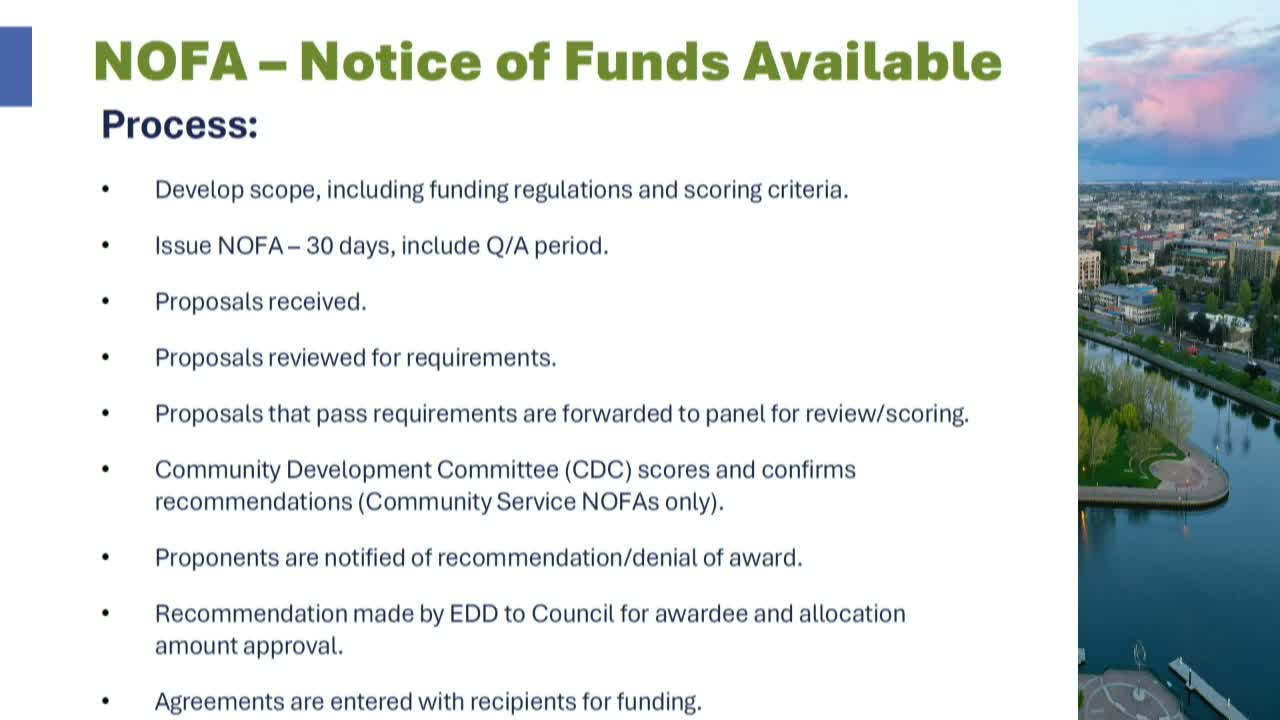
Tina McCarty, acting economic development director, told the council entitlement funding from the U.S. Department of Housing and Urban Development (HUD) and the state’s Department of Housing and Community Development (HCD) flows to Stockton each year in programs such as CDBG, ESG and HOME. She described NOFAs as a parallel to procurement processes: the city posts a scope and eligibility rules, accepts proposals (typically for 30 days), holds a Q&A period and forwards compliant proposals to a scoring panel.
“The scoring is very specific,” McCarty said, explaining panels score categories such as financing plans, operations and developer experience and apply deductions in cases of past environmental findings or failures in timeliness. She said recent 2024 NOFA reviews showed deductions where prior projects had environmental issues or where applicants had not met reporting or timeliness obligations.
Council members pressed staff about transparency. Vice Mayor Lee argued proposers and the public need clearer feedback on why awards were denied. “We don’t watch the Super Bowl and not have a scorecard,” Lee said, calling for applicants to get the equivalent of a report card explaining point allocations.
Staff described changes already underway: separating the initial responsiveness checklist from panel raters so one staff member does not both disqualify and later score the same application; offering one-on-one review sessions for proposers who request an explanation of their ratings; and evaluating whether it is legally permissible to publish scoring sheets more broadly. McCarty said some recent opportunities allowed proposers or council members to review ratings in closed sessions, and staff will check with legal about releasing more information online.
Council members also sought a more consistent performance-monitoring cadence for funded projects and clearer rules about when and how funds are deobligated if projects do not advance. McCarty explained that many entitlement programs run on multi-year cycles (she cited an eight-year obligation horizon for some HOME funds) and that deobligation or reallocation becomes an issue when projects repeatedly miss milestone timelines.
The session included discussion of a specific local dispute: a developer (referred to during council remarks as Hunter House/Service First) did not move forward on a project and received an obligation letter; staff said the group was denied some funding for conflict-of-interest concerns (in the public services NOFA) and that the applicant’s overall scoring was low. Juan Gonzalez, housing manager, clarified that the conflict-of-interest questions staff cited were tied to the public services NOFA rather than the housing NOFA and that some awards were deobligated when projects were not able to meet expenditure timeliness.
No formal votes were taken; the session was informational. Staff recommended procedural changes to reduce conflicts and increase clarity and said they will continue outreach and capacity-building efforts for local nonprofits that apply for NOFA funding.