Get Full Government Meeting Transcripts, Videos, & Alerts Forever!
Get email alerts on the Municipal Priorities topic
No spam. Unsubscribe anytime.
Stockton council workshop prioritizes public safety and homelessness, asks staff for measurable next steps
Summary
At a daylong priority-setting workshop, Stockton councilmembers signaled public safety (including expanded youth activities) and homelessness as top near‑term priorities, with infrastructure investment close behind. The city manager agreed to return with measurable actions tied to the long‑range financial plan.
Stockton — Councilmembers at a priority‑setting workshop highlighted public safety and homelessness as the city’s top short‑term priorities on Friday, and asked staff to return with measurable actions the city can take within current budget constraints.
The facilitated session, led by consultants from Raftelis, collected council input through a visioning exercise then asked members to place three sticker votes on a short list. The results showed six votes each for “enhancing public safety” (the Council explicitly linked that item to expanded youth programming) and “addressing homelessness,” five votes for “infrastructure investment and maintenance,” and one vote for “environmental sustainability.” Facilitators recommended that staff return with verifiable, time‑bounded actions tied to the priorities and report progress every three to six months.
“Public safety is not just about uniformed officers,” said Vice Mayor Lee during the discussion, urging investment in prevention, youth programming and community partnerships. Councilmember comments repeatedly tied a safer city to more youth programs and better-maintained parks and facilities.
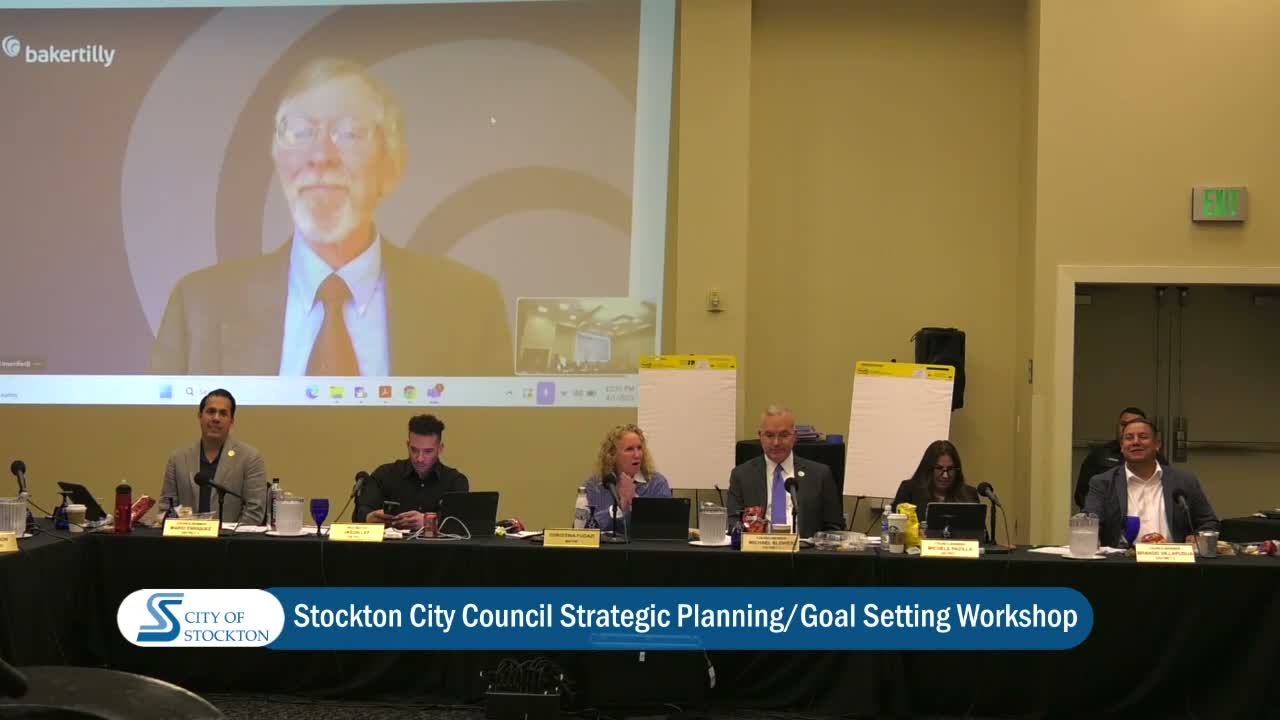
Bob Leland of Baker Tilly, who presented Stockton’s updated long‑range financial plan earlier in the day, told the Council the city must balance ambitious priorities with fiscal reality. The LRFP assumes conservative growth and that Measure A is renewed in fiscal 2034; modest ongoing spending increases, Leland said, can produce multi‑year budget pressure absent corrective actions.
Interim City Manager Steve Colangelo committed to translating the Council’s priorities into a set of measurable actions and to return with proposals during the budget process. “I will commit to that,” he said, while noting his contract is scheduled to expire in August.
Councilmembers and staff repeatedly emphasized the need for discipline: facilitators and consultants urged the Council to limit the number of “top” priorities so staff can focus resources and deliver results. The Council did not make any binding legislative commitments at the workshop; the sticker exercise served to guide budgeting and work plans for the coming year. The manager agreed to present specific staff work plans and budget implications tied to the chosen priorities as part of the upcoming fiscal process.