Get Full Government Meeting Transcripts, Videos, & Alerts Forever!
Get email alerts on the Public Infrastructure Districts topic
No spam. Unsubscribe anytime.
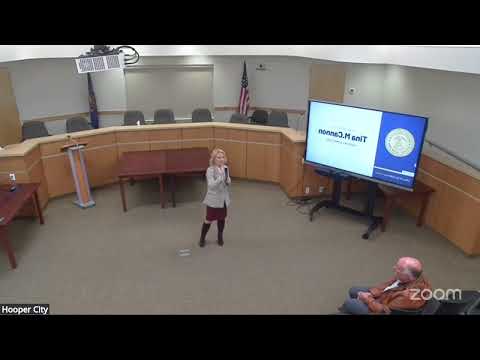
State auditor warns Hooper City planners that public infrastructure districts create long-term taxpayer risks
Summary
A state auditor told Hooper City Planning that public infrastructure districts (PIDs) can create persistent tax lines, complicate municipal finances, and lack consistent reporting; the auditor cited Colville/Walhalla bankruptcy, gave local examples, and urged legislative and local policy fixes.
At a Hooper City Planning meeting, the state auditor (name not specified) warned that public infrastructure districts, a financing tool used for development, can create long-running tax obligations that risk pricing out buyers and tying up municipal borrowing capacity.
The auditor said PID levies can become an extra, long-term line on property tax bills and cited one example of a homeowner charge of "$325 per month." She told planners that under current law PID levies may be allowed to rise unchecked because state reporting and statutory limits are not enforcing a hard cap. "You will price yourself out" of a home, she said, if buyers are already stretching to afford a mortgage and then face an added PID tax line.
The presentation highlighted a recent audit finding. The auditor said the city of Colville had not included a PID project called Walhalla in its financial statements; the state auditor's office alerted the city and required restatements for 2022–24. "Walhalla is in bankruptcy," the auditor said, and the office is examining how such liabilities affect municipal debt limits and future bonding capacity.
The speaker also raised a statewide sizing concern, saying PID exposure "is currently for public infrastructure districts, 4 times the amount that is being carried by the state of Utah in general obligation bonds," an assertion the auditor presented as evidence that PID debt can be significant relative to traditional state debt.
Noncontiguous annexation — where developers secure approval from a friendly city or county for land that is not physically connected — featured as a central risk in the talk. The auditor warned that noncontiguous annexation allows developers to shop for permissive jurisdictions and can leave communities with responsibility for PID-related obligations without clear control. "You are now responsible because what is yet to be determined is if you build it, remember who approved it, who gets to include it in their financial statements," she said.
The auditor described several operational problems: PID boards and ownership can change hands without notifying cities or the state; municipalities often learn about bond issuances from third-party bond reporters rather than from developers or boards; and state-level accounting and legal guidance have not kept pace with rapid PID growth. She said the state auditor's office currently reports about "54% compliance" on PID reporting despite hiring staff dedicated to tracking districts.
Large projects attracted particular attention. The auditor cited Wasatch Peaks Resort as an example of scale, noting bonds in the hundreds of millions of dollars (she referenced a $300,000,000 bond) and saying market demand for higher-yield municipal-style instruments is fueling PID issuance. She warned that when speculative development fails, taxpayers can be left covering the costs.
The auditor urged local policymakers to adopt guardrails in local policy and asked legislators to consider changes to statutory rules governing noncontiguous annexation and PID reporting. She said she has communicated concerns to the legislature and expects some resistance, especially for state-authorized "super PIDs," but recommended that cities and counties create clear local policies and consult their attorneys about which rules govern land-use and financial reporting.
No formal motions or votes were recorded in the transcript. The presentation closed with the auditor reiterating her oversight role and inviting questions.
Provenance: The article summarizes and quotes material presented across the recorded presentation to Hooper City Planning; topic text appears from the meeting transcript beginning at SEG 001 and continuing through SEG 559.