
Great Salt Lake inflow likely to be well below average; recovery would require millions of acre-feet, Snow Survey says
Get AI-powered insights, summaries, and transcripts
Subscribe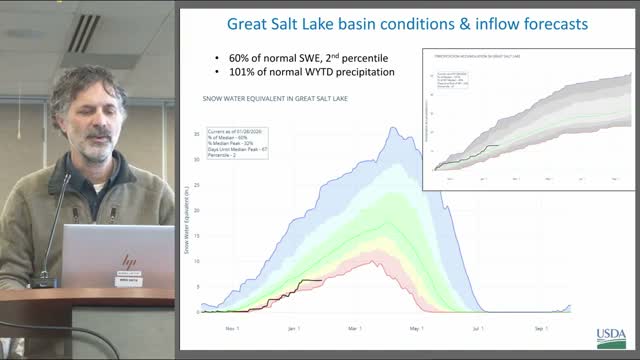
Summary
Jordan Clayton said 2026 inflow to the Great Salt Lake is expected to be substantially lower than average; he estimated April–July runoff at about 410,000 acre-feet and said roughly 4.87 million acre-feet would be needed to raise the lake to a 4,198-foot target.
Jordan Clayton, supervisor of the Utah Snow Survey, presented historical inflow and storage figures for the Great Salt Lake and said projections point to substantially below-average inflow for 2026. "We anticipate the 2026 inflow to be substantially lower than average," Clayton said.
He gave context for the scale of recovery. Clayton said the April–July runoff forecast used for planning was about 410,000 acre-feet and noted average annual inflow to the lake is about 1.3 million acre-feet. He said current lake storage is roughly 8.6 million acre-feet and that restoring the lake to a target elevation of about 4,198 feet would require on the order of 4.87 million acre-feet—roughly 3.7 years' worth of average annual flow.
Clayton emphasized the uncertainty in those ballpark calculations and the imprecision of current rating-curve–based estimates: "That's about 4.87 or so million acre feet that would need to be added, which is the equivalent of about 3.7 years worth of annual flow." He cautioned that the April–July forecast captures only the primary runoff season and that other inflows outside those months also matter for the lake's annual balance.
He said the January 1 forecast projected a rise in lake level on the order of about 0.2 to nearly 2 feet (probabilistic range) with a mid-range (median) of about 1 foot, but that February 1 projections will likely be lower given weak January precipitation for snow. Clayton reiterated that without much higher-than-normal runoff the lake is unlikely to recover quickly.
Clayton closed by noting short-term forecasts show the possibility of a light storm in early February and a larger pattern change around Feb. 9–10, but he emphasized reliance on updated probabilistic forecasts before drawing firm conclusions about lake recovery.