Get Full Government Meeting Transcripts, Videos, & Alerts Forever!
Get email alerts on the Affordable Housing Pilot topic
No spam. Unsubscribe anytime.
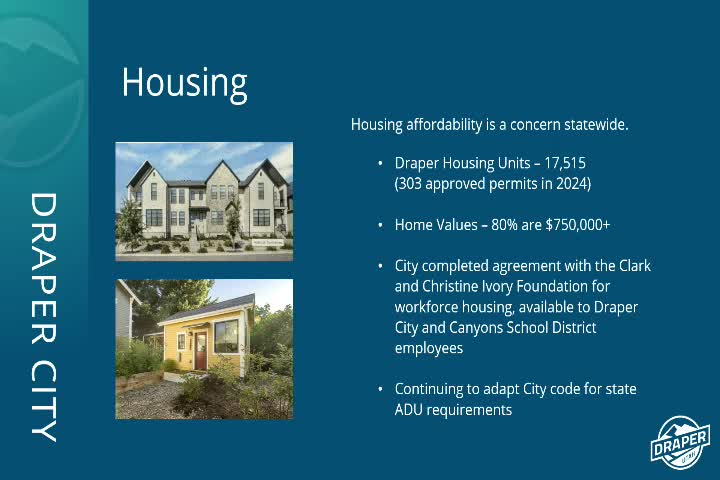
Draper partners with Ivory Foundation on nine-unit ownership pilot to help local workers
Summary
Mayor Walker described a pilot using CDBG funds to subsidize nine townhomes targeted at public-safety and school district employees, with resale capped at a roughly 4% annual growth to recycle subsidy funds.
Mayor Walker described a small home-ownership pilot aimed at providing affordable, targeted housing for city employees, public-safety workers and Canyon School District staff. The city has partnered with the Clark and Christine Ivory Foundation to develop nine townhome units, using community-development funds the mayor referred to (he said the acronym aloud as 'CBDG' and acknowledged he could not remember the exact expansion).
Walker said the units will be made available to police officers, firefighters and Canyon School District employees with deed restrictions that limit annual resale appreciation to about 4% so the subsidy can be recycled for future buyers. He characterized the pilot as government intervention focused on ownership rather than rental assistance and said ownership was a priority so that local workers could capture equity and remain in the community.
Why it matters: Draper’s land and construction costs are high (the mayor estimated raw land values near $1.2 million per acre and said typical new single-family starting prices in parts of Draper approach $1.2 million), so the city is testing small, targeted programs that use federal and local housing-related funds to preserve long-term affordability for designated workforce groups.
Walker acknowledged limitations: high land costs, market forces and the risk that subsidies can be absorbed into higher prices. He described the pilot as an experiment and said the city plans to pursue similar targeted ownership programs if the first effort succeeds.